
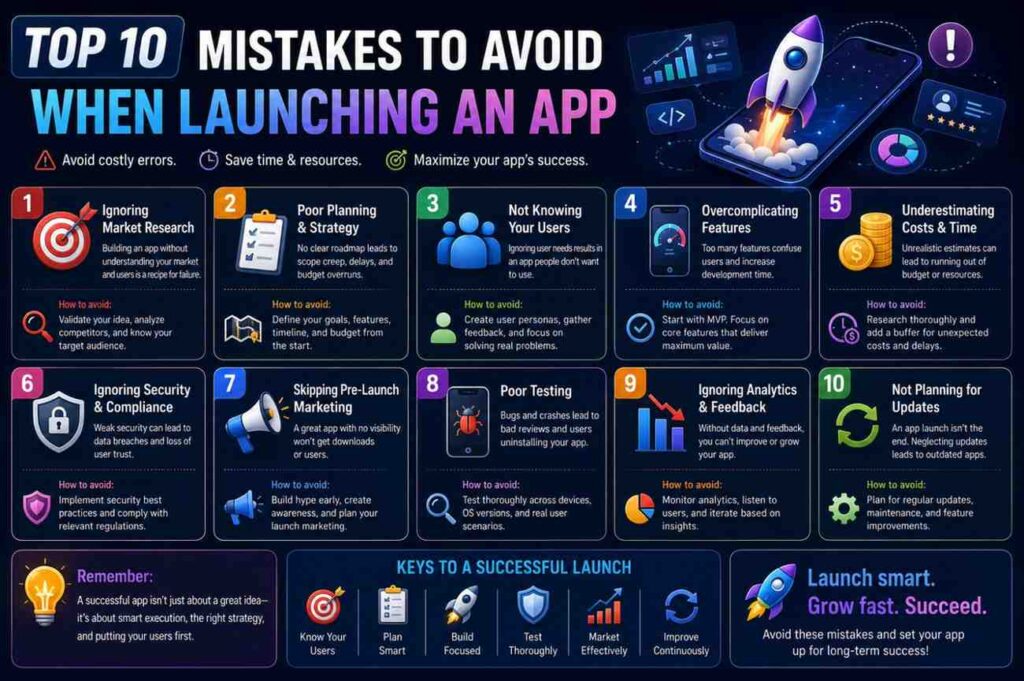
Top 10 Mistakes to Avoid When Launching an App
Launching an app is one of the most critical and sensitive stages in the entire product lifecycle. It is the moment when an idea transitions from development into the real world, where actual users evaluate its usefulness, usability, and overall performance. Many teams mistakenly believe that building the app is the most challenging part, but in reality, the launch phase often determines whether the product succeeds or gets lost in a highly competitive market.
From a strategic perspective, a successful app launch requires far more than just technical completion. It involves careful planning, market understanding, user testing, and strong marketing execution. Without these elements, even a well-designed and fully functional app can fail to gain traction. This is why understanding common mistakes before launching is essential for long-term success.
Over the years, it has become clear that the difference between successful and unsuccessful apps is not just code quality, but how effectively the product is positioned and delivered to users. Many failures occur due to poor research, weak user experience decisions, or lack of proper promotion. By identifying and avoiding these mistakes early, developers and businesses can significantly improve their chances of building a successful and sustainable application.
Introduction
Launching a mobile application is not simply about publishing it to an app store. It is a structured process that involves understanding users, validating ideas, preparing marketing systems, and ensuring that the product is ready for real-world usage. Without these essential steps, even a well-designed app can struggle to gain traction or retain users after launch.
A successful launch requires coordination between multiple disciplines, including development, design, marketing, and analytics. Each of these areas plays a crucial role in shaping how users perceive and interact with the application. When any one of these elements is overlooked, it can significantly reduce the chances of long-term success.
Why App Launches Fail So Often
Most app failures occur because teams underestimate how competitive the mobile ecosystem has become. With millions of apps available on platforms like the Apple App Store and Google Play Store, users have endless alternatives for nearly every need. In such a saturated environment, simply building a functional app is no longer enough to guarantee success.
Another common reason for failure is the lack of real user insight during development. Many applications are created based on assumptions rather than validated user needs, leading to weak engagement and poor retention. Even technically strong apps can fail if they do not solve a meaningful problem or offer a noticeably better experience than existing solutions.
Importance of a Structured Launch Plan
A structured launch plan provides the foundation for a successful mobile application by aligning all key teams and processes into a single coordinated strategy. It ensures that product decisions are guided by research, user feedback, and measurable goals rather than assumptions or guesswork.
With a clear plan in place, each stage of the launch process serves a defined purpose—from market research and MVP development to testing and marketing execution. This structured approach helps reduce risk, improve product quality, and significantly increase the likelihood of achieving strong user adoption after launch.
Key Areas We Will Cover
This article focuses on the most critical mistakes that can impact an app’s success at different stages of its lifecycle. These include strategic errors made during planning, technical issues during development, and growth-related challenges after release in the market.
We will examine areas such as market research, product-market fit, MVP strategy, user experience design, testing processes, marketing execution, and data-driven optimization. Each of these elements plays a vital role in determining whether an app can succeed in a highly competitive digital environment or fail to gain traction.
Quick Answer About Top 10 Mistakes to Avoid When Launching an App
The most common mistakes when launching an app include skipping proper market research, failing to validate product-market fit, overbuilding features instead of focusing on a simple MVP, and ignoring user experience design. These issues often lead to apps that are difficult to use, poorly aligned with user needs, and unable to compete effectively in a crowded marketplace.
Another major mistake is launching without sufficient testing or a clear marketing strategy. Without proper quality assurance and pre-launch promotion, even a well-developed app can suffer from bugs, low visibility, and weak initial adoption. Many developers also overlook App Store Optimization (ASO), which significantly reduces discoverability on platforms like the App Store and Google Play.
After launch, a common failure is ignoring analytics and user feedback. Without tracking user behavior, retention rates, and engagement patterns, teams miss critical insights needed for improvement and growth. Successful app launches require a balanced approach that integrates development, design, marketing, and continuous optimization to ensure long-term success.
Mistake 1 – Skipping Market Research
Skipping market research is one of the most common and critical mistakes in app development. Many teams become excited about an idea and immediately start building without understanding whether there is real demand for it. This often leads to wasted time, unnecessary development costs, and products that fail to gain traction after launch because they do not solve a meaningful user problem.
Market research is the foundation of any successful app because it ensures that development efforts are guided by real-world data rather than assumptions. Without this step, teams risk building features that users do not need or prioritizing functionality that has no market value. Proper research helps reduce uncertainty and provides a clear direction for product development from the very beginning.
Why Market Research Matters
Market research is essential because it helps validate whether your app idea addresses a genuine problem in the market. Instead of relying on assumptions, research allows developers to understand existing solutions, user expectations, and gaps that can be improved or solved more effectively. This significantly reduces the risk of building an irrelevant or outdated product.
It also helps determine whether an idea has long-term potential or is simply a short-lived trend. Many apps fail because they target temporary demand without considering sustainability. Through proper research, teams can focus on building solutions that have consistent user interest, ensuring better chances of long-term success in a competitive market.
Understanding Your Target Audience
Understanding your target audience is one of the most important outcomes of effective market research. Successful apps are not designed for everyone; instead, they are tailored to a specific group of users with defined needs, behaviors, and pain points. This clarity helps shape both product design and feature prioritization.
When developers understand their audience deeply, they can create features that directly solve real problems and improve user satisfaction. It also helps in designing better onboarding flows, user interfaces, and marketing strategies that resonate with the intended audience. Without this focus, apps often become too generic and fail to build strong user engagement.
Tools for Market Validation
Market validation can be achieved using a combination of research methods and analytical tools. Studying industry trends helps determine whether demand for an idea is growing or declining, while competitor analysis provides insights into what already exists in the market and where improvements can be made.
Direct user feedback is equally important for validation. Surveys, interviews, and early landing page tests can help measure interest before development begins. These techniques reduce uncertainty, minimize risk, and provide valuable direction for building a product that aligns with real user needs.
Mistake 2 – Ignoring Product-Market Fit
Product-market fit is one of the most important indicators of whether a mobile app will succeed or fail in a competitive market. Without it, even a well-designed and technically advanced application will struggle to gain traction because it does not fully align with what users actually need or expect. Many apps fail not because of poor development, but because they never reach this critical stage of validation.
Achieving product-market fit means that the app naturally resonates with a specific audience and becomes something they genuinely rely on. When this happens, user growth becomes more organic, retention improves, and marketing becomes significantly more effective because users begin to promote the app through word-of-mouth.
What Is Product-Market Fit?
Product-market fit refers to the stage where an application successfully solves a real and meaningful problem for a clearly defined group of users. At this point, users are not only downloading the app but actively using it because it adds consistent value to their daily lives or workflows.
When an app reaches product-market fit, it often experiences faster and more sustainable growth. Users start recommending it to others, engagement levels increase, and the product begins to establish a strong position in its target market. This is often the turning point between a struggling app and a successful one.
Signs You Don’t Have Product-Market Fit
When product-market fit is missing, the signs are usually easy to identify. Users may download the app initially but stop using it shortly after. Retention rates remain low, and engagement drops significantly after the first few interactions, indicating that the app is not delivering ongoing value.
Another strong indicator is the lack of organic growth. If users are not actively recommending the app or sharing it with others, it usually means the product is not compelling enough to create natural advocacy. Even strong marketing campaigns will struggle to produce long-term results without product-market fit.
How to Achieve Product-Market Fit
Achieving product-market fit requires continuous testing, feedback collection, and iteration rather than building a fully featured product from the beginning. A more effective approach is to start with a simple version of the app, often referred to as an MVP, and release it to a targeted group of users.
Feedback from real users should then be used to refine and improve the product over time. Features that do not add value should be removed or adjusted, while useful features should be enhanced. This iterative process ensures that the app evolves in alignment with user needs and steadily moves toward strong product-market fit.
Mistake 3 – Weak MVP Launch Strategy
A weak MVP (Minimum Viable Product) strategy often leads to poorly balanced apps that are either too complex at launch or too minimal to provide real value. In both cases, the result is the same—users fail to engage meaningfully with the product. Finding the right balance between simplicity and functionality is essential for early-stage success and long-term scalability.
The MVP stage is one of the most important phases in app development because it determines whether the core idea actually works in the real world. If handled correctly, it provides clarity, reduces risk, and ensures that future development is based on real user feedback rather than assumptions.
Why MVP Matters
A Minimum Viable Product is designed to launch a simplified version of an app that includes only its core features. The primary goal is not perfection but validation—confirming whether users actually need and value the solution being offered. This approach allows teams to test their ideas in real-world conditions before committing significant time and resources.
An MVP also plays a critical role in reducing development risk. By shortening development cycles and launching early, teams can gather real user feedback and behavioral data. This information helps guide future updates, ensuring that improvements are based on actual usage patterns rather than internal assumptions or guesswork.
Common MVP Errors
One of the most common MVP mistakes is overloading the initial version with too many features. Instead of focusing on a single core problem, teams often try to include multiple functionalities, which increases complexity and delays meaningful learning. This defeats the purpose of an MVP and makes it harder to understand user behavior.
Another frequent issue is ignoring user feedback after launch. Some teams continue building based on internal opinions rather than analyzing how real users interact with the product. Additionally, failing to define clear success metrics makes it difficult to evaluate whether the MVP is performing well or needs improvement.
Building the Right MVP
A strong MVP should focus on solving one core problem in the simplest possible way. It should be lightweight, easy to use, and designed specifically for testing assumptions about user needs and behavior. The goal is to validate the idea as quickly as possible without unnecessary complexity.
Once the MVP is released, continuous improvement becomes essential. Feedback should be actively collected and used to refine features, improve usability, and eliminate unnecessary elements. This iterative approach ensures that the product evolves in the right direction and gradually becomes a fully developed, user-driven solution.
Mistake 4 – Poor UX/UI Design
User experience (UX) and user interface (UI) design play a crucial role in determining whether users continue using an app or abandon it shortly after installation. Even if an application has strong functionality and advanced features, poor design can quickly frustrate users and lead to low engagement and high uninstall rates. In today’s competitive app market, design quality is just as important as technical performance.
Good UX/UI design ensures that users can navigate the app easily, understand its purpose quickly, and complete actions without confusion. When an app feels intuitive and visually consistent, it naturally increases user satisfaction, retention, and overall success. This makes design one of the most important factors in app adoption and long-term growth.
First Impressions Matter
First impressions are extremely important in mobile app design because users form an opinion within seconds of opening an app. If the interface appears cluttered, confusing, or visually unappealing, users are likely to exit immediately without exploring further. This initial reaction can significantly impact retention rates and overall app performance.
A clean, simple, and intuitive interface helps users quickly understand how the app works and what value it offers. Clear layouts, readable typography, and well-structured navigation encourage users to explore more features. When users feel comfortable during their first interaction, they are more likely to stay engaged and return to the app later.
Common UX Mistakes
One of the most common UX mistakes is overly complex navigation structures that make it difficult for users to find what they need. When users struggle to understand how to move through an app, frustration increases, and engagement decreases rapidly. Simple and logical navigation is essential for a smooth user experience.
Another major issue is inconsistent design elements such as varying button styles, colors, or layouts across different screens. This inconsistency reduces trust and makes the app feel unprofessional. Additionally, poor readability, slow loading times, and unclear interactions further degrade usability and negatively impact the overall experience.
Improving User Experience
Improving UX requires a strong focus on simplicity, clarity, and user-centered design principles. Every screen in an app should serve a clear purpose, and users should always understand what action they need to take next without confusion. Reducing unnecessary elements helps create a more focused and efficient user journey.
Performance optimization is equally important because even well-designed apps fail if they are slow or unresponsive. Fast loading times, smooth transitions, and responsive interactions significantly improve user satisfaction. By combining clean design with strong performance, developers can create apps that feel both intuitive and enjoyable to use.
Mistake 5 – Lack of Proper Testing
Testing is one of the most critical stages in mobile app development, yet it is often underestimated or rushed. Without proper testing, even well-designed applications can suffer from bugs, crashes, poor performance, and security vulnerabilities after launch. This not only affects user experience but also damages trust and long-term adoption.
A strong testing strategy ensures that the app functions smoothly across different devices, operating systems, and real-world usage conditions. It helps developers identify and fix issues early, reducing the cost and effort required for post-launch updates and maintenance.
| App Launch Mistake | What It Means in Practice | Impact on App Performance | Key Improvement Strategy |
|---|---|---|---|
| Skipping market research | Building an app without validating demand or user needs | Low adoption, wasted development effort, weak positioning | Conduct competitor analysis, user surveys, and demand testing before development |
| Ignoring product-market fit | Launching without confirming real user demand alignment | High uninstall rates and poor retention | Use MVP testing and continuous user feedback loops |
| Weak MVP strategy | Overbuilding features instead of focusing on core functionality | Delayed launch and confused user experience | Focus only on essential features that solve one core problem |
| Poor UX/UI design | Complicated or inconsistent interface design | Users abandon app quickly after first use | Simplify navigation, improve onboarding, and optimize performance |
| Lack of testing | Releasing app without proper beta or usability testing | Bugs, crashes, and negative reviews | Conduct beta testing, performance testing, and usability testing |
| Weak marketing strategy | No structured user acquisition plan before launch | Low visibility and poor downloads | Build pre-launch campaigns and multi-channel marketing strategy |
| Ignoring ASO | Poor app store optimization practices | Low discoverability in app stores | Optimize keywords, visuals, and metadata for store ranking |
| Ignoring analytics | Not tracking user behavior after launch | No data-driven improvements possible | Use analytics tools to monitor retention, engagement, and conversions |
Importance of Beta Testing Apps
Beta testing allows real users to interact with the application before its official release. This phase is extremely valuable because it exposes the app to real-world conditions that cannot always be replicated during internal testing. Users may discover bugs, usability issues, or performance problems that developers might overlook.
In addition to identifying technical issues, beta testing provides insights into user behavior and expectations. It helps developers understand how people actually use the app, which features are most valuable, and where users face confusion. This feedback is essential for refining the product before a full-scale launch.
Types of Testing You Should Do
A comprehensive testing strategy should include multiple types of testing to ensure app quality. Functionality testing verifies that all features work as intended without errors. Usability testing focuses on user experience, ensuring the app is intuitive, easy to navigate, and user-friendly.
Performance testing is equally important, as it measures how the app behaves under different conditions such as high traffic or limited device resources. This helps ensure stability, speed, and responsiveness, which are critical for retaining users in competitive app markets.
Real User Feedback
Real user feedback is one of the most valuable resources during the testing phase. Unlike internal assumptions, real users interact with the app in unpredictable ways and often uncover issues that developers may not anticipate. This makes their feedback highly practical and actionable.
By analyzing user responses, developers can identify pain points, improve features, and refine the overall experience before the official release. Incorporating this feedback early leads to higher app quality, better user satisfaction, and a smoother launch process.
Mistake 6 – Weak App Marketing Strategy
A weak app marketing strategy is one of the most damaging mistakes in mobile app launches because it directly affects visibility, user acquisition, and overall growth. Even a well-developed and highly functional app can fail if potential users are not aware of its existence. Marketing is what connects the product to its audience, making it a critical part of the launch process rather than an optional step.
In today’s highly competitive app ecosystem, thousands of new apps are released every day, which makes it extremely difficult to stand out without a strong marketing plan. Successful apps are not only built well but also positioned effectively in front of the right audience through consistent and strategic promotion.
Why Marketing Matters More Than Development
While app development focuses on building functionality, marketing determines whether users will ever discover and download the app. Without visibility, even the most advanced features and best user experience have no impact because no one is using the product. This is why marketing is often considered more important than development in terms of overall success.
Marketing also ensures that the app reaches the right target audience instead of random users who are unlikely to engage. A well-planned marketing strategy helps communicate the app’s value, build trust, and create demand before and after launch. This early awareness significantly improves adoption rates and long-term user retention.
Key Marketing Channels
Successful app marketing typically relies on multiple channels working together rather than a single source of traffic. Social media platforms are widely used to build awareness, engage audiences, and create viral content around the app. Influencer partnerships also play a key role by leveraging trusted voices to promote the product to relevant user groups.
Content marketing is another powerful channel that helps educate users and build organic traffic over time. Blog posts, videos, tutorials, and reviews can significantly improve brand visibility and credibility. When combined effectively, these channels create a strong ecosystem that drives consistent app installs and engagement.
App Store Optimization Tips
App Store Optimization (ASO) is essential for improving an app’s visibility on platforms like the Apple App Store and Google Play Store. It involves optimizing keywords, app titles, descriptions, and visual elements such as icons and screenshots to increase discoverability.
High-quality ratings and reviews also play a major role in ASO performance, as they influence user trust and ranking in search results. By continuously improving these elements, developers can significantly increase organic downloads and reduce reliance on paid advertising.
Mistake 7 – Ignoring App Store Optimization (ASO)
Ignoring App Store Optimization (ASO) is a major mistake that can severely limit an app’s visibility and organic growth. In highly competitive app marketplaces like the Apple App Store and Google Play Store, millions of apps compete for user attention. Without proper optimization, even a high-quality app may remain undiscovered by its target audience.
ASO plays a critical role in ensuring that your app appears in relevant search results and attracts the right users. It directly impacts downloads, visibility, and long-term growth, making it an essential part of any successful app launch strategy.
What Is ASO?
App Store Optimization (ASO) is the process of improving an app’s visibility within app stores by optimizing its metadata, keywords, descriptions, visuals, and overall presentation. The goal of ASO is to increase organic downloads by making the app more discoverable to users searching for relevant solutions.
ASO works similarly to SEO but is focused on mobile app marketplaces. By carefully selecting keywords and improving visual appeal, developers can significantly increase their chances of ranking higher in search results and attracting more installs without relying heavily on paid advertising.
Common ASO Mistakes
One of the most common ASO mistakes is using weak or irrelevant keywords that do not match user search behavior. This reduces the chances of the app appearing in search results, leading to lower visibility and fewer downloads. Poor keyword research often results in missed opportunities for organic growth.
Another major issue is neglecting app visuals such as icons, screenshots, and preview videos. Low-quality visuals can reduce user trust and discourage downloads. Additionally, ignoring user reviews and ratings can negatively impact app ranking, as feedback plays a key role in store algorithms and user decision-making.
Improving ASO Performance
Improving ASO performance requires a combination of keyword optimization, visual enhancement, and active reputation management. Using relevant, high-traffic keywords in the app title and description helps improve search rankings and discoverability.
Equally important are high-quality visuals that clearly communicate the app’s value and functionality. Developers should also actively manage user reviews by responding to feedback and encouraging satisfied users to leave positive ratings. Together, these strategies significantly improve organic reach and overall app performance.
Mistake 8 – Ignoring Analytics and Post-Launch Data
Ignoring analytics and post-launch data is a serious mistake that prevents apps from reaching their full potential. Once an app is launched, the real learning process begins, and data becomes the most important tool for understanding how users interact with the product. Without tracking performance, teams are essentially working blindly, making decisions based on assumptions rather than real evidence.
In a competitive app market, continuous improvement is essential for survival. User expectations change quickly, and apps that fail to adapt based on data often lose relevance over time. Analytics provide the insights needed to refine features, improve user experience, and optimize overall performance.
Why Data Matters
Data is essential because it reveals how users actually behave inside the app, rather than how developers expect them to behave. Analytics tools help identify patterns, highlight issues, and uncover opportunities for improvement that may not be visible during development or testing phases.
By analyzing user behavior, developers can make informed decisions that improve engagement, usability, and retention. This data-driven approach reduces guesswork and ensures that updates are aligned with real user needs, ultimately increasing the chances of long-term app success.
Key Metrics to Track
Tracking the right metrics is crucial for understanding app performance. Retention rate is one of the most important indicators, as it shows how many users continue using the app after their first interaction. Engagement metrics, such as session duration and active usage, help measure how involved users are with the app.
Conversion rates are also essential, especially for apps with monetization goals such as subscriptions or in-app purchases. Together, these metrics provide a clear picture of how well the app is performing and where improvements are needed.
Improving Based on Data
Data should always guide product development, UX improvements, and marketing strategies. Instead of relying on assumptions, teams should use analytics insights to identify what is working and what is not. This ensures that every update adds real value to the user experience.
By continuously analyzing and acting on data, developers can refine features, improve usability, and optimize marketing campaigns. This ongoing feedback loop is essential for building a successful, scalable, and user-focused application.
| Launch Stage | Core Focus Area | Common Risk if Ignored | Best Practice Approach | Outcome When Done Right |
|---|---|---|---|---|
| Pre-Development Stage | Market research and idea validation | Building unwanted or unneeded product | Validate demand using surveys, trends, and competitor analysis | Clear direction and reduced failure risk |
| Planning Stage | Product-market fit definition | Misaligned product and user needs | Define target audience and core value proposition | Strong user relevance and engagement |
| MVP Development Stage | Core feature development | Overcomplicated or delayed product launch | Build only essential features first | Faster validation and lower cost |
| Testing Stage | QA and beta testing | Bugs and poor user experience at launch | Conduct structured beta testing and usability tests | Stable, user-ready product |
| Launch Stage | App store publishing and visibility | Low downloads and poor ranking | Optimize ASO and launch marketing campaigns | Strong visibility and initial traction |
| Growth Stage | Marketing and user acquisition | No user growth or weak retention | Use paid ads, organic content, and referral systems | Sustainable user acquisition |
| Post-Launch Stage | Analytics and optimization | No product improvement cycle | Track KPIs like retention, engagement, and churn | Continuous product improvement |
Frequently Asked Questions
Frequently Asked Questions (FAQs) provide quick and clear answers to the most common doubts users have about launching a mobile app. This section is designed to simplify complex topics and help readers understand key concepts without going through the entire guide in detail. It is especially useful for beginners who need fast, practical insights.
In the context of app launches, FAQs cover important areas such as planning, development, marketing, testing, and post-launch optimization. By summarizing essential information in an easy-to-read format, this section helps readers make informed decisions and avoid common mistakes that often lead to app failure.
What are the most common app launch mistakes?
The most common app launch mistakes include poor planning, lack of market research, weak UX/UI design, insufficient testing, and ineffective marketing strategies. These issues often lead to low user engagement, poor retention, and ultimately higher failure rates after launch.
Many apps also struggle because they skip essential steps such as MVP validation and post-launch optimization. Without a structured approach, even a well-built app can fail to attract and retain users in a highly competitive market.
Why do most mobile apps fail after launch?
Most mobile apps fail after launch because they do not achieve product-market fit or fail to generate enough user interest. Without solving a real problem or providing strong value, users quickly abandon the app after initial use.
Another major reason is weak marketing execution. Even good apps struggle to succeed if they are not properly promoted or positioned in front of the right audience, leading to low visibility and poor adoption rates.
How can I successfully launch a mobile app?
A successful mobile app launch requires a combination of MVP development, thorough testing, ASO optimization, and a strong marketing strategy. Each stage plays a critical role in ensuring that the app is functional, discoverable, and valuable to users.
In addition, collecting user feedback and continuously improving the app after launch is essential. This helps refine features, improve user experience, and increase long-term retention and growth.
What is the role of ASO in app launch success?
App Store Optimization (ASO) plays a crucial role in app launch success by improving visibility in app stores like Google Play and the Apple App Store. It helps apps rank higher in search results and attract organic downloads without relying heavily on paid advertising.
Effective ASO includes optimizing keywords, improving app descriptions, using high-quality visuals, and maintaining strong ratings and reviews. Together, these factors significantly increase discoverability and user acquisition.
How important is beta testing before launch?
Beta testing is extremely important before launching an app because it allows real users to test the product in real-world conditions. This helps identify bugs, usability issues, and performance problems that may not appear during internal testing.
By gathering feedback from beta users, developers can make necessary improvements before the official release. This leads to a more stable, user-friendly, and reliable app, increasing the chances of a successful launch.
Conclusion
Avoiding the Top 10 Mistakes to Avoid When Launching an App is essential for building a successful and sustainable digital product. A successful launch is not defined by development alone, but by a complete process that includes research, validation, user experience design, testing, marketing, and post-launch optimization. Each of these elements plays a critical role in determining how well an app performs in the real world.
When these factors are properly aligned, they create a strong foundation for user acquisition, engagement, and retention. Apps that follow a structured approach are more likely to stand out in competitive marketplaces, attract the right audience, and deliver consistent value over time.
Ultimately, long-term success depends on continuous improvement and the ability to adapt based on user feedback and data insights. By avoiding common mistakes and focusing on a strategic launch process, developers and businesses can significantly increase their chances of building a high-performing and successful mobile application.