
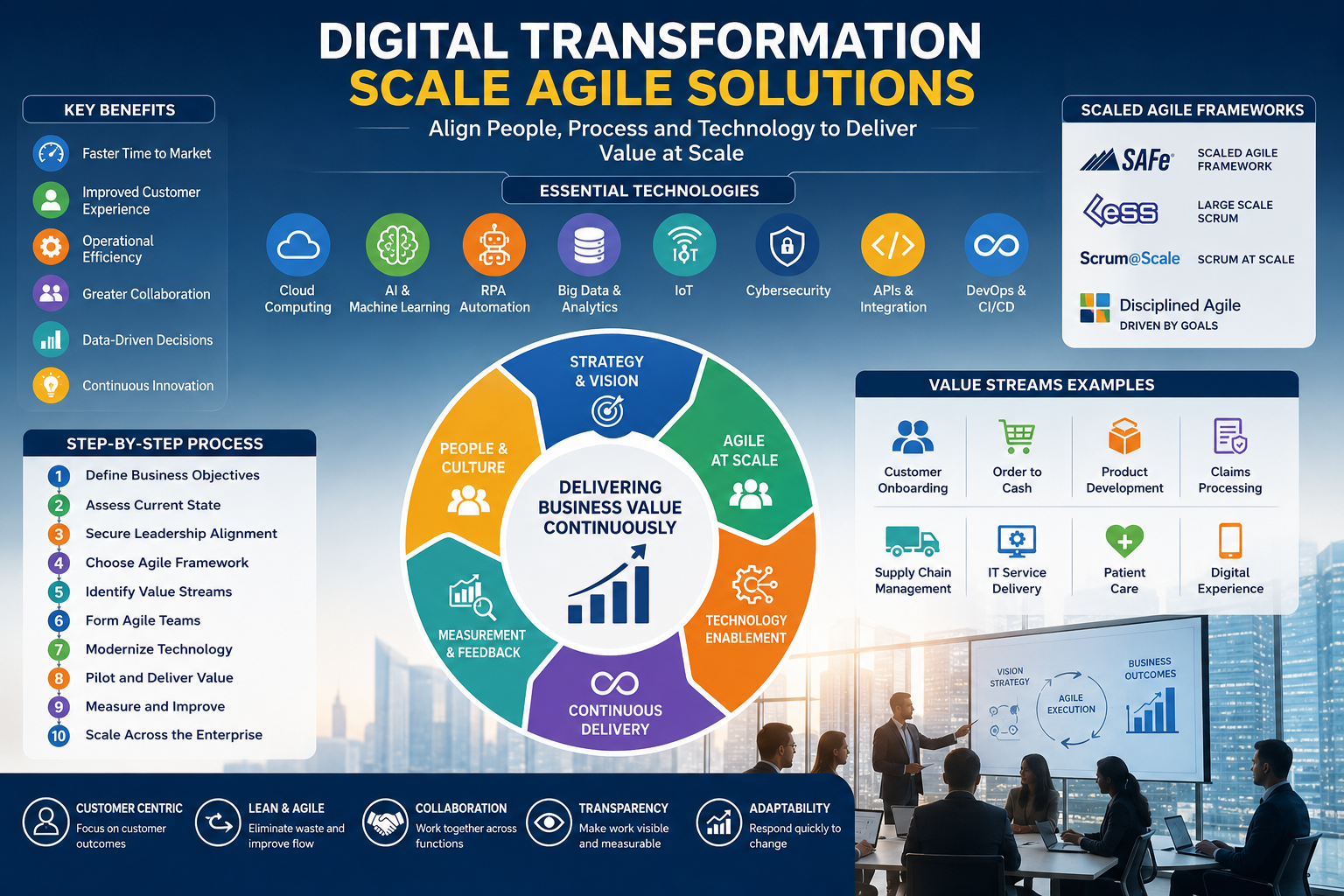
Introduction to Digital Transformation Scale Agile Solutions
In today’s rapidly evolving business environment, digital transformation scale agile solutions have become essential for organizations that want to innovate faster, improve customer experiences, and remain competitive. Companies across every industry are facing increasing pressure to modernize legacy systems, automate operations, and deliver digital products at a much faster pace than ever before.
At the same time, traditional project management methods are often too slow and rigid to support large-scale transformation. This is where scaled agile solutions play a critical role. By extending agile principles across the enterprise, organizations can coordinate hundreds or even thousands of employees around a common vision while delivering value incrementally.
When businesses combine digital transformation with agile transformation at scale, they create a powerful framework for continuous innovation. Technology teams, business leaders, and operations departments work together in short cycles, testing ideas quickly and responding to market changes in real time.
What Are Digital Transformation Scale Agile Solutions?
Digital transformation scale agile solutions refer to the integration of digital technologies and enterprise-level agile methodologies to transform how organizations operate, innovate, and serve customers.
This approach combines two major strategies:
- Digital Transformation – Using technologies such as cloud computing, artificial intelligence, automation, and data analytics to modernize business processes.
- Scaled Agile Solutions – Applying frameworks like the Scaled Agile Framework (SAFe), Large-Scale Scrum (LeSS), and Scrum@Scale across multiple teams and departments.
Together, these strategies enable organizations to:
- Deliver products faster
- Reduce operational inefficiencies
- Improve collaboration
- Increase adaptability
- Accelerate innovation
- Enhance customer satisfaction
Why Digital Transformation and Scaled Agile Are a Perfect Match
Digital transformation requires organizations to experiment, learn quickly, and continuously improve. Agile methodologies are specifically designed for these purposes.
Shared Principles Between Digital Transformation and Agile
| Digital Transformation Goal | Agile Principle |
|---|---|
| Faster innovation | Iterative development |
| Customer-centricity | Continuous feedback |
| Operational efficiency | Cross-functional collaboration |
| Risk reduction | Incremental delivery |
| Adaptability | Responding to change |
Both approaches focus on delivering value, embracing change, and making decisions based on data and customer insights.
The Growing Importance of Digital Transformation Scale Agile Solutions
According to research from McKinsey & Company and Gartner, organizations that successfully combine digital transformation with agile practices often achieve:
- Faster product development cycles
- Higher employee engagement
- Improved customer satisfaction
- Better alignment between business and IT
- Greater return on technology investments
Large enterprises are increasingly adopting enterprise agile solutions to overcome common transformation challenges such as departmental silos, slow decision-making, and resistance to change.
Real-World Example of Digital Transformation Scale Agile Solutions
Imagine a large retail company launching a new e-commerce platform.
Traditional Approach
- Requirements are documented upfront.
- Development takes 12–18 months.
- Customer feedback arrives only after launch.
- Errors are expensive to fix.
Digital Transformation Scale Agile Approach
- Teams release updates every two weeks.
- Customer feedback is collected continuously.
- AI analytics personalize shopping experiences.
- Cloud infrastructure scales automatically.
- Business leaders adjust priorities in real time.
The result is faster innovation, lower risk, and significantly better customer outcomes.
Key Components of Digital Transformation Scale Agile Solutions
1. Technology Modernization
Organizations replace outdated systems with cloud platforms, APIs, and scalable architectures.
2. Agile Governance
Leadership establishes lean portfolio management and strategic prioritization.
3. Cross-Functional Teams
Developers, designers, analysts, and business stakeholders collaborate closely.
4. Continuous Delivery
DevOps pipelines automate testing and deployment.
5. Data-Driven Decision-Making
Real-time dashboards guide priorities and investments.
6. Cultural Change
Employees adopt a mindset of experimentation and continuous learning.
Benefits at a Glance
| Benefit | Business Impact |
|---|---|
| Faster Time to Market | Launch products and features quickly |
| Higher Productivity | Reduce waste and duplication |
| Improved Customer Experience | Deliver more relevant digital services |
| Greater Flexibility | Adapt to changing market conditions |
| Better Collaboration | Align business and technology teams |
| Reduced Risk | Validate ideas early and often |
| Increased Revenue | Accelerate innovation and growth |
Who Should Use Digital Transformation Scale Agile Solutions?
These solutions are especially valuable for:
- Large enterprises
- Government agencies
- Financial institutions
- Healthcare organizations
- Manufacturers
- Retailers
- Telecommunications companies
- Fast-growing technology firms
Any organization managing complex projects across multiple teams can benefit from agile digital transformation.
Common Questions Business Leaders Ask
Before adopting digital transformation scale agile solutions, leaders often ask:
- How do we modernize legacy systems without disrupting operations?
- Which scaled agile framework is best for our organization?
- How long does transformation take?
- What metrics should we track?
- How do we gain executive buy-in?
- What technologies are required?
- How much will the initiative cost?
- How do we measure ROI?
This guide will answer all of these questions in detail.
A Powerful Quote About Transformation
“It is not the strongest organizations that survive, but the ones most responsive to change.”
This principle captures why digital transformation scale agile solutions are so effective. They provide the structure, tools, and mindset organizations need to respond quickly to evolving customer expectations and competitive pressures.
What You Will Learn in This Complete Guide
In the following sections, you will discover:
- What digital transformation really means
- How scaled agile solutions work
- Why SAFe is widely used in enterprises
- Technologies that support transformation
- Step-by-step implementation strategies
- Best practices and common pitfalls
- Real-world case studies
- Metrics for measuring success
- Future trends shaping enterprise agility
Key Takeaways from This Introduction
- Digital transformation scale agile solutions combine technology modernization with enterprise agile frameworks.
- They enable organizations to innovate faster and reduce risk.
- Scaled agile frameworks like SAFe help coordinate multiple teams.
- Technology, culture, and leadership are all critical for success.
- Enterprises across every industry are adopting this approach to stay competitive.
What Is Digital Transformation?
Digital transformation is the process of using modern technologies to fundamentally improve how an organization operates, delivers value to customers, and competes in the market. It is much more than installing new software or moving data to the cloud. True digital transformation changes business models, operating processes, company culture, and decision-making.
In the context of digital transformation scale agile solutions, digital transformation provides the technological and strategic foundation, while scaled agile methods provide the execution model that allows organizations to implement change quickly and effectively.
Simply put:
Digital transformation is about reimagining the business using technology.
Organizations that embrace digital transformation do not just automate existing processes. They redesign how work is done, how customers interact with the company, and how employees collaborate across departments.
Simple Definition of Digital Transformation
A straightforward definition is:
Digital transformation is the strategic use of digital technologies to improve business processes, enhance customer experiences, and create new sources of value.
This can involve technologies such as:
- Cloud computing
- Artificial intelligence (AI)
- Machine learning
- Data analytics
- Robotic process automation (RPA)
- Internet of Things (IoT)
- Cybersecurity platforms
- Mobile applications
When combined with scaled agile solutions, these technologies can be implemented iteratively rather than through large, high-risk projects.
Why Digital Transformation Matters in 2026 and Beyond
The business landscape is changing faster than ever. Customers expect personalized, seamless digital experiences. Competitors launch innovative products quickly. New technologies disrupt entire industries.
Companies that fail to modernize risk becoming irrelevant.
Key Drivers of Digital Transformation
| Driver | Description |
|---|---|
| Customer Expectations | People demand fast, convenient, and personalized services |
| Competitive Pressure | Digital-first companies disrupt traditional markets |
| Operational Efficiency | Automation reduces costs and improves accuracy |
| Data Availability | Organizations can make better decisions using analytics |
| Remote Work | Digital tools enable distributed teams |
| Cybersecurity Needs | Modern systems offer stronger protection |
| Innovation Opportunities | Technology enables new business models |
Core Components of Digital Transformation
Digital transformation includes several interconnected areas.
1. Technology Modernization
Organizations replace outdated legacy systems with scalable and flexible platforms such as:
Modern technology infrastructure allows faster development, better integration, and improved security.
2. Process Optimization
Manual and inefficient workflows are redesigned and automated to increase speed and accuracy.
Examples include:
- Automated invoice processing
- Self-service customer portals
- Real-time inventory management
- Digital approval workflows
3. Data-Driven Decision-Making
Companies use dashboards, analytics, and predictive models to guide strategy.
Instead of relying solely on intuition, leaders make decisions based on measurable insights.
4. Customer Experience Transformation
Digital transformation focuses heavily on improving the customer journey through:
- Personalized recommendations
- Mobile apps
- Chatbots
- Omnichannel support
- Faster service delivery
5. Cultural and Organizational Change
Technology alone does not create transformation. Employees and leaders must adopt:
- Continuous learning
- Collaboration
- Experimentation
- Customer-centric thinking
- Agility
Digital Transformation vs Digitization vs Digitalization
These terms are often confused, but they are different.
| Term | Meaning | Example |
|---|---|---|
| Digitization | Converting analog information into digital form | Scanning paper files |
| Digitalization | Using digital tools to improve processes | Online billing |
| Digital Transformation | Reimagining the business using technology | Launching a fully digital customer platform |
Digital transformation is the broadest and most strategic concept.
Real-World Examples of Digital Transformation
Banking
Banks use AI-powered fraud detection, mobile banking apps, and automated loan approvals.
Healthcare
Hospitals implement telemedicine, electronic health records, and predictive diagnostics.
Retail
Retailers deploy personalized product recommendations and omnichannel shopping experiences.
Manufacturing
Factories adopt smart sensors and predictive maintenance systems.
Education
Universities deliver online learning platforms and AI-based tutoring systems.
How Digital Transformation Supports Business Growth
Digital transformation directly contributes to improved performance.
Revenue Growth
New digital products and services open additional revenue streams.
Cost Reduction
Automation reduces manual labor and operational waste.
Faster Innovation
Organizations launch and test ideas more rapidly.
Better Customer Retention
Enhanced experiences increase loyalty and repeat business.
Stronger Competitive Advantage
Companies adapt quickly to changing market conditions.
The Role of Leadership in Digital Transformation
Successful transformation requires strong executive sponsorship.
Leaders must:
- Define a clear vision
- Allocate resources
- Remove barriers
- Promote cultural change
- Measure outcomes
Without leadership commitment, transformation initiatives often lose momentum.
Common Misconceptions About Digital Transformation
“It’s Just an IT Project”
Digital transformation affects every part of the business, not only the technology department.
“Buying New Software Is Enough”
Technology is only one piece. Strategy, culture, and processes are equally important.
“Transformation Has a Fixed End Date”
Digital transformation is an ongoing journey of continuous improvement.
“Only Large Enterprises Need It”
Businesses of all sizes can benefit from digital transformation.
Digital Transformation Maturity Levels
Organizations typically progress through several stages.
| Stage | Characteristics |
|---|---|
| Initial | Limited digital capabilities |
| Emerging | Basic automation and digital tools |
| Integrated | Connected systems and data |
| Optimized | Advanced analytics and automation |
| Transformative | Innovation-driven and highly agile |
Scaled agile solutions help organizations move more quickly through these maturity levels.
Why Digital Transformation Alone Is Not Enough
Many organizations invest heavily in technology but struggle to achieve meaningful results.
Common reasons include:
- Slow execution
- Departmental silos
- Lack of prioritization
- Poor change management
- Inadequate collaboration
This is why digital transformation scale agile solutions are so powerful. Agile frameworks provide the structure needed to turn strategic vision into measurable outcomes.
Digital Transformation and Scaled Agile: A Strategic Partnership
Digital transformation defines what needs to change.
Scaled agile solutions define how change is delivered.
Together they enable organizations to:
- Prioritize high-value initiatives
- Deliver incremental improvements
- Respond quickly to feedback
- Coordinate multiple teams
- Sustain long-term innovation
This combination significantly increases the likelihood of transformation success.
Mini Case Study: Manufacturing Company Transformation
A global manufacturer relied on legacy systems and manual planning processes.
After adopting cloud-based platforms and scaled agile practices:
- Product development cycles were reduced by 40%
- Equipment downtime decreased by 25%
- Customer order accuracy improved significantly
- Teams delivered updates every two weeks
The company transformed both its technology foundation and its operating model.
Key Takeaways
- Digital transformation is a strategic business initiative, not just a technology upgrade.
- It involves technology, processes, data, customer experience, and culture.
- Organizations across all industries are adopting digital strategies.
- Leadership and organizational change are critical for success.
- Digital transformation scale agile solutions combine strategic modernization with rapid execution.
What Are Scale Agile Solutions?
Scale agile solutions are methods, frameworks, tools, and practices that extend agile principles beyond a single team to the entire organization. While a small software team can use Scrum or Kanban effectively on its own, large enterprises often have dozens or even hundreds of teams working on interconnected products, systems, and initiatives.
Without coordination, these teams can create duplication, conflicting priorities, and delays. Scale agile solutions solve this challenge by providing a structured way to align strategy, execution, and delivery across the business.
In the broader context of digital transformation scale agile solutions, scaled agile frameworks help organizations turn ambitious transformation goals into coordinated action. They connect executives, product managers, architects, developers, and operations teams so everyone works toward shared business outcomes.
Scaled agile solutions allow enterprises to apply agile thinking at organizational scale.
Why Agile Must Be Scaled Across the Enterprise
Traditional agile methods were designed for small, self-managing teams. However, enterprise transformation requires collaboration among many groups, including:
- Software development
- IT operations
- Cybersecurity
- Product management
- Finance
- Marketing
- Human resources
- Executive leadership
When these groups work independently, transformation efforts often stall.
Common Problems Without Scaled Agile Solutions
| Challenge | Impact |
|---|---|
| Siloed departments | Poor communication and duplicated work |
| Misaligned priorities | Teams work on low-value initiatives |
| Slow approvals | Delayed product releases |
| Unclear ownership | Accountability gaps |
| Inconsistent processes | Reduced efficiency |
| Limited visibility | Leadership cannot track progress |
Scaled agile solutions introduce governance, planning, and collaboration mechanisms that keep all teams aligned.
Core Principles of Scale Agile Solutions
Most enterprise agile frameworks are built around several common principles.
Customer-Centricity
Teams prioritize features and improvements that create measurable customer value.
Alignment
Business and technology teams share strategic goals and common priorities.
Transparency
Progress, risks, and dependencies are visible to everyone.
Incremental Delivery
Work is delivered in small, testable increments.
Continuous Improvement
Teams inspect results and adapt based on feedback.
Decentralized Decision-Making
Decisions are made as close to the work as possible.
Popular Scale Agile Solutions and Frameworks
Several frameworks help organizations implement agile at scale.
Scaled Agile Framework (SAFe)
The most widely adopted enterprise agile framework. SAFe combines Lean, Agile, and DevOps principles and provides guidance for strategy, portfolio management, and delivery.
Large-Scale Scrum (LeSS)
Extends Scrum to multiple teams working on a single product while keeping processes lightweight.
Scrum@Scale
Created by Jeff Sutherland, this framework focuses on scaling networks of Scrum teams across organizations.
Disciplined Agile (DA)
Offered by Project Management Institute (PMI), DA provides a toolkit-based approach to enterprise agility.
Nexus Framework
Developed by Scrum.org to coordinate multiple Scrum teams working on a common product.
Comparison of Leading Scaled Agile Frameworks
| Framework | Best For | Complexity | Popularity |
|---|---|---|---|
| SAFe | Large enterprises | High | Very High |
| LeSS | Simpler product organizations | Medium | Moderate |
| Scrum@Scale | Flexible enterprise adoption | Medium | Growing |
| Disciplined Agile | Customized process design | Medium | Moderate |
| Nexus | Multi-team Scrum implementations | Medium | Moderate |
Among these, SAFe is the most common choice for organizations implementing digital transformation scale agile solutions because it addresses both strategy and execution.
Key Elements of Scale Agile Solutions
Agile Release Trains (ARTs)
Long-lived teams of teams, typically 50–125 people, that deliver value together on a fixed cadence.
Program Increment (PI) Planning
A structured planning event where all teams align on priorities and dependencies.
Lean Portfolio Management
A governance model that connects investment decisions to business strategy.
DevOps and Continuous Delivery
Automation practices that enable frequent and reliable releases.
Value Streams
The end-to-end flow of activities that deliver value to customers.
How Scale Agile Solutions Support Digital Transformation
Digital transformation initiatives often include:
- Cloud migration
- Customer experience redesign
- Data platform development
- Process automation
- Mobile application development
- Cybersecurity modernization
These initiatives usually involve many interdependent teams.
Scale agile solutions help by:
- Coordinating priorities across departments
- Reducing bottlenecks
- Increasing visibility
- Managing dependencies
- Accelerating delivery
This structured approach ensures transformation work remains aligned with business objectives.
Roles in Enterprise Agile Solutions
Scaled agile frameworks define clear responsibilities.
| Role | Primary Responsibility |
|---|---|
| Product Manager | Defines priorities and business value |
| Release Train Engineer | Facilitates coordination and execution |
| System Architect | Guides technical design |
| Scrum Master | Supports team effectiveness |
| Product Owner | Manages team backlog |
| Business Owner | Provides strategic oversight |
| Agile Coach | Drives adoption and improvement |
These roles create accountability and improve decision-making.
Benefits of Scale Agile Solutions
Organizations implementing enterprise agile solutions often experience:
- Faster time to market
- Improved cross-functional collaboration
- Higher quality releases
- Greater transparency
- Better strategic alignment
- Increased employee engagement
- Reduced project risk
- Stronger customer focus
Real-World Example: Financial Services Transformation
A large bank had more than 80 technology teams working on digital products. Releases were infrequent, and priorities often conflicted.
After adopting SAFe:
- Teams aligned during quarterly PI Planning
- Deployment frequency increased significantly
- Product lead times were cut nearly in half
- Business and IT collaboration improved
- Customer-facing features reached the market faster
This illustrates how scaled agile solutions provide the operating model needed for enterprise transformation.
Common Misconceptions About Scaling Agile
“Agile Cannot Work in Large Organizations”
Modern frameworks were specifically designed for complex enterprises.
“Scaling Agile Adds Too Much Bureaucracy”
When implemented properly, frameworks reduce waste and improve focus.
“Only Technology Teams Need Agile”
Marketing, finance, and operations can also benefit from agile practices.
“SAFe Is the Only Option”
Organizations should select the framework that best matches their structure and goals.
When Your Organization Needs Scale Agile Solutions
You should consider scaling agile if:
- Multiple teams work on shared products
- Strategic initiatives span several departments
- Dependencies cause frequent delays
- Releases are slow and unpredictable
- Leadership lacks visibility
- Digital transformation efforts are struggling
These are strong indicators that enterprise coordination needs improvement.
Key Takeaways
- Scale agile solutions extend agile principles across the enterprise.
- Frameworks such as SAFe, LeSS, and Scrum@Scale provide proven implementation models.
- They align strategy, teams, and technology investments.
- Scaled agile is a critical enabler of digital transformation.
- Digital transformation scale agile solutions combine modernization with coordinated execution.
How Digital Transformation and Scale Agile Solutions Work Together
Digital transformation and scaled agile are most effective when implemented together. Digital transformation defines the strategic vision for how an organization will modernize technology, redesign processes, and improve customer experiences. Scale agile solutions provide the delivery system that turns that vision into consistent, measurable results.
In simple terms:
- Digital transformation answers what the organization wants to achieve.
- Scale agile solutions explain how the organization will deliver it.
When combined, digital transformation scale agile solutions create a practical operating model that helps enterprises innovate continuously, reduce risk, and adapt quickly to changing market demands.
Strategy without execution produces little value. Scaled agile gives digital transformation the execution engine it needs.
Shared Principles Between Digital Transformation and Agile
Both approaches are built on similar principles, which is why they complement each other so well.
Customer-Centric Thinking
Transformation initiatives focus on solving real customer problems and improving experiences.
Continuous Improvement
Teams test ideas, gather feedback, and refine solutions iteratively.
Data-Driven Decision-Making
Metrics and analytics guide priorities and investments.
Cross-Functional Collaboration
Business, technology, and operations teams work together rather than in silos.
Adaptability
Organizations respond quickly to market changes, customer needs, and new technologies.
A Simple Visual Model
Business Strategy
        ↓
Digital Transformation Goals
        ↓
Technology Investments
        ↓
Scaled Agile Execution
        ↓
Continuous Delivery
        ↓
Customer Value and Business Growth
This model shows how strategy flows into execution and ultimately produces measurable outcomes.
How Scaled Agile Accelerates Digital Transformation
1. Faster Delivery of Digital Initiatives
Traditional transformation programs often rely on lengthy planning cycles and large releases. This approach delays feedback and increases risk.
Scaled agile breaks large initiatives into smaller increments delivered every few weeks. Teams validate assumptions early and make adjustments before significant resources are wasted.
2. Better Alignment Between Business and IT
Many organizations struggle because business leaders set priorities while technical teams work independently.
Scaled agile creates structured collaboration through:
- Program Increment (PI) Planning
- Shared backlogs
- Joint prioritization
- Regular review sessions
This ensures everyone is working toward the same strategic goals.
3. Improved Visibility and Transparency
Executives gain real-time insight into:
- Progress
- Risks
- Dependencies
- Capacity
- Outcomes
This visibility supports better governance and more informed decisions.
4. Reduced Transformation Risk
Incremental delivery allows organizations to:
- Test new technologies on a small scale
- Gather user feedback quickly
- Correct issues early
- Avoid costly failures
5. Sustainable Innovation
Teams continuously experiment and improve, creating an innovation culture rather than treating transformation as a one-time project.
Real-World Example: Cloud Migration at Scale
A multinational insurance company planned to migrate hundreds of applications to the cloud.
Before Scaled Agile
- Projects were managed separately.
- Teams competed for resources.
- Dependencies caused frequent delays.
- Leadership had limited visibility.
After Implementing SAFe
- Teams were organized around value streams.
- PI Planning aligned priorities every quarter.
- DevOps pipelines automated deployments.
- Cloud migration milestones were delivered incrementally.
Results
- Migration speed increased significantly.
- Infrastructure costs were reduced.
- Release quality improved.
- Customer-facing applications became more reliable.
This demonstrates how digital transformation scale agile solutions help organizations manage large, complex change initiatives successfully.
Technology and Agile Working Together
Digital transformation introduces new technologies, while scaled agile ensures they are implemented effectively.
| Technology | Agile Contribution |
|---|---|
| Cloud Computing | Enables rapid provisioning and experimentation |
| Artificial Intelligence | Supports data-driven innovation |
| Automation | Reduces manual work and accelerates delivery |
| APIs | Facilitate modular development |
| DevOps | Improves deployment speed and reliability |
| Analytics | Provides feedback for continuous improvement |
Together, technology and agile create a high-performance transformation ecosystem.
Organizational Changes Enabled by Digital Transformation Scale Agile Solutions
When these approaches are integrated, organizations often shift from:
| Traditional Model | Agile Digital Model |
|---|---|
| Project-based work | Product-based work |
| Annual planning | Continuous prioritization |
| Department silos | Cross-functional teams |
| Manual processes | Automated workflows |
| Limited feedback | Frequent customer input |
| Slow releases | Continuous delivery |
These changes significantly improve responsiveness and efficiency.
Strategic Benefits of Combining Both Approaches
Increased Speed
Products and services reach the market faster.
Better Customer Outcomes
Frequent feedback leads to more relevant solutions.
Greater Efficiency
Automation and alignment reduce waste.
Stronger Governance
Leadership maintains visibility without micromanaging teams.
Higher Employee Engagement
Teams gain autonomy and a clearer sense of purpose.
Improved ROI
Investments are continuously evaluated based on business impact.
Common Transformation Scenarios Where Scaled Agile Help
Organizations often use digital transformation scale agile solutions for:
- Enterprise cloud migration
- Customer portal redesign
- Core banking modernization
- ERP replacement
- AI and analytics implementation
- Cybersecurity upgrades
- Process automation
- Mobile app development
These initiatives involve many dependencies, making enterprise coordination essential.
Signs Your Transformation Needs Scaled Agile
If your organization experiences any of the following, scaled agile can help:
- Projects consistently miss deadlines
- Teams have conflicting priorities
- Digital initiatives take too long
- Leadership lacks visibility
- Customer feedback is not incorporated quickly
- Technology investments deliver limited results
These symptoms usually indicate execution challenges rather than strategy problems.
Mini Case Study: Retail Digital Transformation
A global retailer launched an omnichannel platform integrating online and in-store experiences.
By combining cloud technologies, AI-driven recommendations, and scaled agile practices:
- Release cycles were shortened from months to weeks
- Personalized promotions increased conversions
- Inventory visibility improved across channels
- Customer satisfaction scores rose significantly
The retailer transformed both its technology architecture and operating model.
Key Takeaways
- Digital transformation sets the strategic direction.
- Scale agile solutions provide the enterprise delivery model.
- Together they create a practical framework for modernization and innovation.
- This combination improves speed, transparency, and business outcomes.
- Digital transformation scale agile solutions help organizations execute complex initiatives with confidence.
Why Enterprises Need Digital Transformation Scale Agile Solutions
Large organizations operate in an environment defined by constant technological change, rising customer expectations, and intense global competition. To remain relevant, enterprises must modernize both their technology landscape and the way they execute strategic initiatives. This is why digital transformation scale agile solutions have become a core priority for business leaders worldwide.
Enterprises are no longer competing only on price or brand reputation. They compete on speed, innovation, customer experience, and operational efficiency. Organizations that can quickly adapt to changing market conditions gain a significant advantage over those relying on outdated systems and rigid management structures.
In the digital economy, the ability to change rapidly is one of the most valuable business capabilities.
Increasing Customer Expectations
Modern customers expect:
- Seamless digital experiences
- Personalized recommendations
- Real-time service
- Mobile accessibility
- Fast issue resolution
- Consistent experiences across channels
Companies such as Amazon, Netflix, and Uber have set new standards for convenience and responsiveness.
To meet these expectations, enterprises need both modern technology and agile delivery capabilities. Digital transformation provides the tools, while scaled agile solutions ensure rapid and continuous implementation.
Competitive Pressure from Digital-First Companies
Startups and technology-driven organizations often release new products in weeks rather than months or years.
These companies benefit from:
- Cloud-native architectures
- Automated deployment pipelines
- Data-driven decision-making
- Agile operating models
Traditional enterprises must adopt enterprise agile solutions and digital transformation strategies to keep pace.
Examples of Industry Disruption
| Industry | Digital Disruptors |
|---|---|
| Retail | E-commerce platforms |
| Banking | Fintech companies |
| Hospitality | Online booking platforms |
| Transportation | Ride-sharing apps |
| Media | Streaming services |
| Healthcare | Telemedicine providers |
Legacy Systems and Technical Debt
Many enterprises depend on decades-old systems that are:
- Expensive to maintain
- Difficult to integrate
- Slow to modify
- Vulnerable to security risks
Legacy technology creates technical debt that limits innovation.
Digital transformation addresses this through:
- Cloud migration
- API integration
- Application modernization
- Data platform upgrades
Scaled agile solutions coordinate these complex efforts across multiple teams and departments.
Organizational Silos
In large organizations, departments often work independently with different priorities and limited communication.
Common silo-related issues include:
- Duplicate efforts
- Conflicting objectives
- Delayed decisions
- Poor customer experiences
- Resource inefficiencies
Scaled agile frameworks align teams around shared goals and value streams, breaking down these barriers.
Need for Faster Time to Market
Product launches that once took a year must now happen in weeks.
Organizations that deliver quickly can:
- Capture market opportunities
- Respond to competitors
- Test innovations rapidly
- Increase customer satisfaction
Traditional vs Agile Delivery Speed
| Approach | Typical Release Cycle |
|---|---|
| Waterfall | 6–18 months |
| Team-Level Agile | 2–4 weeks |
| Scaled Agile with DevOps | Continuous to biweekly |
Remote and Distributed Workforces
Global enterprises often operate across multiple countries and time zones.
Digital transformation and scaled agile support distributed collaboration through:
- Cloud platforms
- Shared planning tools
- Video conferencing
- Digital workspaces
- Automated reporting
These capabilities are essential for maintaining alignment and productivity.
Rising Cybersecurity and Compliance Requirements
Regulatory and security demands continue to grow, particularly in industries such as:
- Finance
- Healthcare
- Government
- Telecommunications
Modern digital platforms offer stronger security controls, while scaled agile embeds compliance into development processes through automated testing and governance.
Pressure to Improve Operational Efficiency
Enterprises must continuously reduce costs while improving service quality.
Digital transformation enables:
- Process automation
- Predictive analytics
- Self-service tools
- Intelligent workflows
Scaled agile ensures these initiatives are prioritized and delivered effectively.
Demand for Data-Driven Decision-Making
Leaders need accurate, real-time information to make informed decisions.
Digital transformation provides advanced analytics and business intelligence tools, while agile governance ensures teams act on insights quickly.
Benefits include:
- Better forecasting
- Smarter investments
- Faster issue detection
- More precise customer targeting
Employee Expectations and Talent Retention
Skilled professionals increasingly prefer organizations that:
- Use modern tools
- Encourage innovation
- Empower teams
- Offer learning opportunities
Agile operating models improve autonomy and collaboration, which can increase engagement and retention.
Mergers, Acquisitions, and Business Expansion
Enterprises frequently integrate new systems, teams, and processes after acquisitions.
Digital transformation scale agile solutions help organizations:
- Standardize operations
- Align priorities
- Integrate technology platforms
- Deliver synergies more quickly
Market Volatility and Economic Uncertainty
Economic shifts, supply chain disruptions, and changing regulations require organizations to adjust rapidly.
Agile enterprises can:
- Reprioritize investments
- Redirect resources
- Launch new offerings
- Respond to risks faster
This adaptability strengthens resilience.
Executive-Level Benefits
For senior leaders, digital transformation scale agile solutions provide:
- Greater visibility into strategic initiatives
- Improved capital allocation
- Faster return on investments
- Stronger governance
- Reduced execution risk
- Sustainable innovation
These benefits make enterprise transformation a board-level priority.
Real-World Example: Global Bank Transformation
A multinational bank faced slow product launches and increasing competition from fintech startups.
After adopting scaled agile and modernizing its digital platforms:
- Mobile features were released every two weeks
- Customer onboarding became largely automated
- Regulatory reporting improved
- Operating costs declined
- Customer satisfaction increased
The bank transformed both technology and organizational processes.
Warning Signs Your Enterprise Needs Transformation
Your organization may need digital transformation scale agile solutions if:
- Innovation is too slow
- Legacy systems hinder progress
- Teams work in silos
- Technology investments deliver weak ROI
- Customers report poor digital experiences
- Competitors are gaining market share
- Strategic initiatives frequently miss deadlines
These signs indicate that both technology and execution models need improvement.
Key Takeaways
- Enterprises face mounting pressure to innovate faster and operate more efficiently.
- Customer expectations and competition continue to rise.
- Legacy systems and silos often prevent progress.
- Scaled agile solutions help coordinate transformation across large organizations.
- Digital transformation scale agile solutions provide the speed, structure, and flexibility required for long-term success.
Key Benefits of Digital Transformation Scale Agile Solutions
Organizations invest in digital transformation scale agile solutions because the combination of modern technology and enterprise agility delivers measurable business value. While digital transformation introduces new capabilities, scaled agile ensures those capabilities are implemented quickly, aligned with strategic goals, and continuously improved.
The result is a more responsive organization that can innovate faster, reduce waste, and create better experiences for customers and employees.
The true benefit of digital transformation scale agile solutions is not technology alone—it is the ability to consistently turn strategy into business results.
Accelerated Innovation
Innovation depends on the ability to test ideas rapidly and learn from real-world feedback.
With scaled agile solutions, organizations:
- Break large initiatives into smaller experiments
- Release features frequently
- Validate assumptions early
- Adjust priorities based on outcomes
Digital technologies such as AI, cloud computing, and analytics provide the tools, while agile methods provide the delivery rhythm.
Business Impact
- Faster product development
- More successful innovation initiatives
- Reduced time between idea and market launch
Faster Time to Market
One of the most significant advantages of enterprise agile solutions is speed.
Traditional transformation projects often require months of planning and development before customers see results. Scaled agile and DevOps shorten this cycle dramatically.
Typical Improvement Areas
- Shorter development cycles
- Faster approvals
- Automated testing and deployment
- Quicker response to market changes
Example
A telecommunications company reduced release cycles from quarterly to biweekly after implementing SAFe and cloud-based DevOps pipelines.
Improved Customer Experience
Digital transformation focuses heavily on customer-centric design.
Organizations can deliver:
- Personalized recommendations
- Seamless mobile experiences
- Faster support
- Self-service capabilities
- Omnichannel interactions
Scaled agile helps teams prioritize customer feedback and release enhancements continuously.
Key Outcomes
- Higher satisfaction scores
- Increased retention
- Stronger brand loyalty
Greater Operational Efficiency
Automation and streamlined workflows reduce manual effort and eliminate redundant activities.
Examples include:
- Automated invoice processing
- Predictive maintenance
- Workflow approvals
- Customer onboarding
Scaled agile ensures these improvements are delivered in a prioritized, coordinated manner.
Efficiency Benefits
- Lower operating costs
- Fewer errors
- Increased productivity
Better Alignment Between Business and IT
Many organizations struggle because business leaders and technology teams operate with different priorities.
Scaled agile solutions create shared planning and governance mechanisms that align:
- Strategic objectives
- Funding decisions
- Product roadmaps
- Delivery priorities
This alignment improves decision-making and ensures investments focus on high-value outcomes.
Increased Transparency and Visibility
Leadership gains better insight into:
- Initiative progress
- Risks and dependencies
- Resource capacity
- Financial performance
- Outcome metrics
This transparency allows executives to make informed adjustments quickly.
Higher Employee Engagement
Agile teams are empowered to make decisions, collaborate closely, and see the impact of their work.
Benefits for employees include:
- Greater autonomy
- Clearer goals
- Continuous learning
- Stronger teamwork
- Increased sense of purpose
Organizations with engaged employees often experience higher retention and productivity.
Reduced Risk
Large transformation initiatives carry significant technical and financial risks.
Digital transformation scale agile solutions reduce risk by:
- Delivering incrementally
- Testing assumptions early
- Using automation to improve quality
- Monitoring outcomes continuously
Problems are identified sooner, when they are less expensive to correct.
Improved Quality
DevOps practices and continuous testing help organizations release more reliable software and services.
Quality improvements include:
- Fewer defects
- Faster bug resolution
- Better performance
- Enhanced security
This leads to more stable digital experiences for customers.
Stronger Return on Investment (ROI)
Investments are prioritized according to business value and evaluated continuously.
Organizations can:
- Stop low-performing initiatives earlier
- Redirect resources to high-impact opportunities
- Measure outcomes more accurately
This improves capital efficiency and overall returns.
Greater Business Agility
Business agility is the ability to sense change and respond effectively.
Organizations become better at:
- Reprioritizing work
- Entering new markets
- Launching new products
- Responding to disruption
This capability is increasingly critical in uncertain and competitive markets.
Scalability Across the Enterprise
Once proven in one area, agile and digital practices can be expanded across:
- Product development
- Marketing
- Finance
- Operations
- Human resources
This creates a unified enterprise operating model.
Compliance and Governance Improvements
Modern platforms and agile governance can strengthen:
- Audit readiness
- Regulatory reporting
- Security controls
- Policy enforcement
Automation reduces manual compliance efforts and improves accuracy.
Summary Table of Benefits
| Benefit | Strategic Impact |
|---|---|
| Accelerated Innovation | Faster experimentation and product launches |
| Faster Time to Market | Quicker response to opportunities |
| Improved Customer Experience | Higher satisfaction and retention |
| Operational Efficiency | Lower costs and increased productivity |
| Business-IT Alignment | Better strategic execution |
| Transparency | Improved leadership decision-making |
| Employee Engagement | Stronger collaboration and retention |
| Reduced Risk | Early issue detection |
| Improved Quality | More reliable releases |
| Higher ROI | Better investment outcomes |
| Business Agility | Greater adaptability |
| Scalability | Enterprise-wide transformation |
Mini Case Study: Healthcare Transformation
A healthcare provider implemented cloud-based patient portals and adopted scaled agile practices.
Results included:
- Faster release of digital health features
- Improved appointment scheduling
- Reduced administrative costs
- Higher patient satisfaction
- Better coordination between clinical and IT teams
This demonstrates how digital transformation scale agile solutions create both operational and customer benefits.
Executive Perspective
For executives, these solutions provide a powerful combination of:
- Strategic flexibility
- Financial discipline
- Operational efficiency
- Innovation capability
- Competitive advantage
- Organizations that master these capabilities are better positioned to grow sustainably.
Key Takeaways
- Digital transformation scale agile solutions generate measurable business benefits.
- They improve innovation, speed, quality, and efficiency.
- Customers, employees, and executives all benefit.
- Risks are reduced while ROI increases.
The Scaled Agile Framework (SAFe) and Digital Transformation
Among all enterprise agile methodologies, the Scaled Agile Framework (SAFe) is one of the most widely adopted approaches for implementing digital transformation scale agile solutions. SAFe combines principles from Agile, Lean, systems thinking, and DevOps into a structured framework that helps large organizations align strategy with execution.
SAFe is especially valuable for enterprises managing complex digital initiatives such as cloud migrations, customer experience redesigns, core system modernization, and enterprise-wide automation.
SAFe provides the operating system that allows large organizations to execute digital transformation with speed, alignment, and governance.
What Is SAFe?
SAFe is a knowledge base and implementation framework developed by Dean Leffingwell. It offers detailed guidance on:
- Team-level agile practices
- Multi-team coordination
- Lean portfolio management
- Architecture and DevOps
- Leadership and culture
The framework is designed to help organizations:
- Deliver customer value faster
- Improve quality
- Reduce delays
- Increase productivity
- Align investments with business goals
SAFe is used by organizations in banking, healthcare, government, manufacturing, and technology sectors worldwide.
Why SAFe Is Popular for Digital Transformation
Digital transformation programs often involve:
- Multiple business units
- Shared platforms
- Regulatory requirements
- Complex dependencies
- Large budgets
SAFe addresses these challenges by providing:
- Clear roles and responsibilities
- Structured planning events
- Portfolio-level governance
- Built-in quality practices
- Continuous delivery guidance
This balance of agility and control makes SAFe highly attractive to large enterprises.
Core Principles of SAFe
SAFe is based on ten core principles that guide decision-making and execution.
1. Take an Economic View
Prioritize work based on cost, value, and opportunity.
2. Apply Systems Thinking
Optimize the entire value stream, not isolated teams.
3. Assume Variability and Preserve Options
Keep multiple options open until sufficient information is available.
4. Build Incrementally with Fast Learning Cycles
Deliver small increments and learn continuously.
5. Base Milestones on Objective Evaluation
Use working solutions rather than documentation alone.
6. Visualize and Limit Work in Progress
Reduce bottlenecks and improve flow.
7. Apply Cadence and Synchronize with Cross-Domain Planning
Establish predictable rhythms for planning and delivery.
8. Unlock Intrinsic Motivation
Empower teams and foster autonomy.
9. Decentralize Decision-Making
Push decisions to those closest to the work.
10. Organize Around Value
Structure teams around customer outcomes rather than functions.
SAFe Configuration Levels
SAFe offers several configurations depending on organizational complexity.
| Configuration | Best For |
|---|---|
| Essential SAFe | Core practices for most organizations |
| Large Solution SAFe | Complex systems requiring many teams |
| Portfolio SAFe | Strategic investment and governance |
| Full SAFe | Comprehensive enterprise implementation |
Many organizations begin with Essential SAFe and expand over time.
Agile Release Trains (ARTs)
One of the most important concepts in SAFe is the Agile Release Train (ART).
An ART is a long-lived team of teams, usually 50–125 people, that:
- Plans together
- Builds together
- Integrates continuously
- Delivers on a shared cadence
ARTs align all participants around common objectives and customer value.
Program Increment (PI) Planning
PI Planning is a collaborative event typically held every 8–12 weeks.
During PI Planning:
- Teams review strategic priorities
- Identify dependencies
- Estimate work
- Commit to objectives
- Develop a coordinated plan
This event is often considered the heartbeat of SAFe because it creates alignment across the enterprise.
Lean Portfolio Management (LPM)
LPM connects business strategy with execution by guiding:
- Investment decisions
- Funding models
- Governance
- Performance measurement
Instead of approving isolated projects, leaders fund value streams and monitor business outcomes.
Key SAFe Roles
| Role | Responsibility |
|---|---|
| Release Train Engineer | Facilitates ART execution |
| Product Manager | Defines features and priorities |
| Product Owner | Manages team backlog |
| Scrum Master | Supports team effectiveness |
| System Architect | Provides technical direction |
| Business Owner | Ensures strategic alignment |
| Lean Portfolio Manager | Oversees investment decisions |
These roles create accountability and coordination at scale.
Built-In Quality and DevOps
SAFe emphasizes quality throughout the development lifecycle.
Practices include:
- Test automation
- Continuous integration
- Continuous delivery
- Security integration
- Performance monitoring
These capabilities are critical for successful digital transformation.
SAFe and Digital Transformation Use Cases
Organizations use SAFe to support:
- Cloud migration
- Core banking modernization
- ERP implementation
- Customer portal redesign
- Data platform development
- AI deployment
- Cybersecurity programs
Because these initiatives involve many dependencies, coordinated planning and governance are essential.
Benefits of SAFe for Digital Transformation Scale Agile Solutions
Organizations adopting SAFe often report:
- Improved strategic alignment
- Faster delivery cycles
- Greater transparency
- Better collaboration
- Higher quality
- Reduced risk
- Stronger ROI
These outcomes make SAFe one of the most effective frameworks for enterprise transformation.
Real-World Example: Insurance Company Transformatio
A global insurance company used SAFe to modernize claims processing and customer self-service platforms.
Results included:
- Release frequency increased from quarterly to biweekly
- Claims processing time was reduced significantly
- Customer satisfaction improved
- Technology and business teams became more aligned
The organization gained both operational efficiency and competitive advantage.
Challenges of Implementing SAFe
Although powerful, SAFe requires:
- Executive commitment
- Training and coaching
- Cultural change
- Patience and discipline
Common obstacles include resistance to change, inconsistent adoption, and insufficient leadership engagement.
When SAFe Is the Right Choice
SAFe is particularly suitable when:
- Many teams work on interconnected products
- Strategic initiatives span multiple departments
- Governance and compliance are important
- Leadership needs visibility and alignment
- Transformation efforts require enterprise coordination
Key Takeaways
- SAFe is one of the leading frameworks for implementing digital transformation scale agile solutions.
- It combines Agile, Lean, and DevOps principles.
- Agile Release Trains and PI Planning create enterprise-wide alignment.
- Lean Portfolio Management links strategy to funding and execution.
- SAFe helps large organizations modernize with speed and control.
Essential Technologies That Support Digital Transformation Scale Agile Solutions
Technology is the foundation of every successful digital transformation initiative. While scaled agile solutions provide the structure for planning and delivery, modern technologies supply the capabilities that allow organizations to automate processes, improve decision-making, and create innovative customer experiences.
In digital transformation scale agile solutions, technology and agile practices work together. Technology enables new possibilities, and agile methods ensure these technologies are implemented incrementally, tested continuously, and aligned with business priorities.
Cloud Computing
Cloud computing is one of the most important enablers of digital transformation.
Leading providers such as Amazon Web Services (AWS), Microsoft Azure, and Google Cloud offer scalable infrastructure, managed services, and advanced analytics capabilities.
Benefits of Cloud Computing
- Rapid infrastructure provisioning
- Reduced capital expenditure
- Global scalability
- High availability
- Enhanced security options
- Faster experimentation
Common Use Cases
- Application modernization
- Data warehousing
- Disaster recovery
- Mobile backends
- AI model deployment
Scaled agile teams can provision cloud environments quickly, enabling rapid development and testing.
Artificial Intelligence and Machine Learning
Artificial intelligence (AI) and machine learning (ML) help organizations automate decisions, identify patterns, and personalize customer experiences.
Business Applications
- Fraud detection
- Predictive maintenance
- Customer recommendations
- Chatbots and virtual assistants
- Demand forecasting
Business Benefits
- Improved accuracy
- Faster decision-making
- Enhanced customer engagement
- Operational efficiency
Agile teams can deploy AI capabilities incrementally, starting with high-value pilot use cases
Robotic Process Automation (RPA)
RPA uses software bots to perform repetitive, rules-based tasks.
Popular vendors include UiPath, Automation Anywhere, and Blue Prism.
Typical Automation Tasks
- Invoice processing
- Data entry
- Employee onboarding
- Report generation
- Compliance checks
Benefits
- Reduced manual effort
- Fewer errors
- Faster processing times
- Lower costs
Big Data and Analytics
Modern organizations generate massive amounts of data from customers, systems, and operations.
Analytics platforms transform this data into actionable insights.
Types of Analytics
- Descriptive analytics
- Diagnostic analytics
- Predictive analytics
- Prescriptive analytics
Common Tools
Data-driven insights help agile teams prioritize the most valuable features and improvements.
Internet of Things (IoT)
IoT connects physical devices to the internet, allowing organizations to monitor and control assets in real time.
Industry Examples
- Smart manufacturing equipment
- Connected vehicles
- Medical monitoring devices
- Retail sensors
Benefits
- Real-time visibility
- Predictive maintenance
- Improved asset utilization
- Enhanced customer services
DevOps and CI/CD Pipelines
DevOps integrates development and operations to automate software delivery.
Common tools include:
CI/CD Benefits
- Automated testing
- Faster deployments
- Consistent releases
- Reduced human error
DevOps is a critical technical practice within scaled agile frameworks like SAFe.
Application Programming Interfaces (APIs)
APIs allow systems to communicate and share data efficiently.
Common Uses
- Payment integrations
- Mobile app services
- Customer data exchange
- Partner ecosystems
Benefits
- Faster development
- Reusable services
- Easier integration
- Greater flexibility
API-driven architectures support modular, scalable digital platforms.
Cybersecurity Solutions
Digital transformation increases the importance of strong security practices.
Modern cybersecurity includes:
- Identity and access management
- Threat detection
- Data encryption
- Security monitoring
- Zero Trust architectures
Leading providers include Palo Alto Networks, CrowdStrike, and Okta.
Security is increasingly embedded into agile development workflows through DevSecOps.
Low-Code and No-Code Platforms
These platforms enable faster application development with minimal coding.
Examples include:
Benefits
- Rapid prototyping
- Citizen development
- Reduced development backlog
Collaboration and Work Management Tools
Distributed agile teams rely on collaboration platforms.
Popular tools include:
These tools support planning, documentation, and communication at scale.
Emerging Technologies Shaping the Future
Additional technologies influencing enterprise transformation include:
- Digital twins
- Blockchain
- Edge computing
- Quantum computing
- Extended reality (XR)
Organizations evaluate these technologies through agile experimentation and pilot programs.
Technology Selection Criteria
When choosing technologies for digital transformation scale agile solutions, consider:
- Strategic alignment
- Scalability
- Security
- Integration capabilities
- Vendor support
- Total cost of ownership
- Ease of adoption
Technology decisions should be guided by business outcomes rather than trends alone.
Summary Table of Essential Technologies
| Technology | Primary Benefit |
|---|---|
| Cloud Computing | Scalability and flexibility |
| AI and Machine Learning | Intelligent automation |
| RPA | Process efficiency |
| Analytics | Data-driven decisions |
| IoT | Real-time visibility |
| DevOps | Faster delivery |
| APIs | Seamless integration |
| Cybersecurity | Risk reduction |
| Low-Code Platforms | Rapid application development |
| Collaboration Tools | Improved teamwork |
Mini Case Study: Manufacturing Modernization
A manufacturing company implemented IoT sensors, cloud analytics, and RPA while using scaled agile teams to coordinate deployment.
Results included:
- Reduced equipment downtime
- Improved production forecasting
- Lower maintenance costs
- Faster implementation cycles
The organization combined advanced technology with agile execution to achieve substantial operational improvements.
Key Takeaways
- Technology is the engine of digital transformation.
- Scaled agile solutions ensure technologies are delivered effectively.
- Cloud, AI, automation, analytics, and cybersecurity are foundational capabilities.
- DevOps and APIs accelerate delivery and integration.
- Digital transformation scale agile solutions rely on both technological innovation and disciplined execution.
Industries Using Digital Transformation Scale Agile Solutions
Digital transformation scale agile solutions are not limited to technology companies. Organizations across nearly every industry are adopting these strategies to modernize operations, improve customer experiences, and accelerate innovation. Although the specific use cases differ by sector, the underlying goal remains the same: use modern technology and enterprise agility to deliver better outcomes faster.
Industries with complex operations, strict regulatory requirements, and rapidly changing customer expectations tend to benefit the most from combining digital transformation with scaled agile frameworks.
Any industry facing pressure to innovate quickly and operate efficiently can benefit from digital transformation scale agile solutions.
Banking and Financial Services
Banks and financial institutions are under constant pressure from fintech startups and evolving customer expectations.
Common Transformation Initiatives
- Mobile banking applications
- Real-time payments
- Fraud detection using AI
- Automated loan processing
- Open banking APIs
- Regulatory reporting automation
Benefits of Scaled Agile in Banking
- Faster feature releases
- Improved compliance coordination
- Better customer onboarding experiences
- Reduced operational costs
Example
Major global banks use SAFe to coordinate hundreds of teams working on digital products, cybersecurity, and core system modernization.
Healthcar
Healthcare organizations are digitizing patient care, administration, and research.
Key Use Cases
- Electronic health records (EHR)
- Telemedicine platforms
- Patient portals
- AI-assisted diagnostics
- Automated scheduling
Benefits
- Improved patient experiences
- Faster access to care
- Reduced administrative burden
- Better data-driven treatment decisions
Scaled agile helps healthcare organizations coordinate clinicians, IT teams, and compliance stakeholders.
Manufacturing
Manufacturers are adopting smart factory technologies and connected systems.
Transformation Examples
- IoT-enabled equipment monitoring
- Predictive maintenance
- Robotics and automation
- Supply chain analytics
- Digital twins
Benefits
- Reduced downtime
- Improved quality
- Lower maintenance costs
- Greater production efficiency
Agile teams deliver modernization initiatives incrementally across plants and business units.
Retail and E-Commerce
Retailers are using digital transformation to create seamless omnichannel experiences.
Key Initiatives
- Personalized product recommendations
- Mobile shopping apps
- Inventory visibility
- Automated fulfillment
- Customer loyalty platforms
Benefits
- Higher conversion rates
- Better customer retention
- Improved inventory management
- Faster merchandising updates
Telecommunications
Telecom providers manage large-scale networks and highly competitive markets.
Transformation Priorities
- 5G deployment
- Self-service customer portals
- Network automation
- Predictive maintenance
- Real-time analytics
Benefits
- Reduced service disruptions
- Faster product launches
- Lower support costs
Scaled agile coordinates network, software, and operations teams across regions.
Government and Public Sector
Government agencies are modernizing citizen services and internal operations.
Common Projects
- Digital identity systems
- Online licensing portals
- Tax automation
- Public safety analytics
- Cloud migration
Benefits
- Improved service accessibility
- Greater transparency
- Reduced processing times
- Better regulatory compliance
Insurance
Insurance companies are digitizing underwriting, claims, and customer engagement.
Use Cases
- Automated claims processing
- Risk modeling
- Customer self-service
- Fraud detection
Benefits
- Faster claims settlement
- Improved accuracy
- Higher customer satisfaction
Education
Universities and schools are investing in digital learning and administrative modernization.
Initiatives
- Learning management systems
- Virtual classrooms
- Student analytics
- Automated admissions
Benefits
- Personalized learning
- Improved student retention
- More efficient administration
Energy and Utilities
Energy companies use digital tools to improve reliability and sustainability.
Transformation Examples
- Smart grids
- Predictive maintenance
- Asset monitoring
- Renewable energy optimization
Benefits
- Reduced outages
- Better asset utilization
- Improved environmental performance
Transportation and Logistics
Logistics organizations rely on digital platforms to optimize movement and visibility.
Key Applications
- Route optimization
- Fleet telematics
- Warehouse automation
- Real-time tracking
Benefits
- Lower fuel costs
- Faster deliveries
- Improved customer communication
Media and Entertainment
Media companies use technology to personalize content and manage digital subscriptions.
Initiatives
- Streaming platforms
- Recommendation engines
- Audience analytics
Benefits
- Higher engagement
- Better retention
- Increased subscription revenue
Pharmaceuticals and Life Sciences
These organizations modernize research, manufacturing, and regulatory processes.
Use Cases
- Clinical trial analytics
- Laboratory automation
- Supply chain monitoring
Benefits
- Faster drug development
- Improved compliance
- Better collaboration
Industry Comparison Table
| Industry | Primary Goals | Common Technologies |
|---|---|---|
| Banking | Customer experience and compliance | AI, APIs, analytics |
| Healthcare | Patient care and efficiency | Telemedicine, EHR, AI |
| Manufacturing | Operational efficiency | IoT, robotics, analytics |
| Retail | Omnichannel personalization | Cloud, AI, automation |
| Telecom | Network and customer automation | 5G, analytics, DevOps |
| Government | Citizen services | Cloud, workflow automation |
| Education | Digital learning | LMS, analytics |
| Logistics | Visibility and optimization | IoT, route analytics |
Cross-Industry Lessons
Despite differences in business models, successful organizations share several practices:
- Strong executive sponsorship
- Clear business objectives
- Customer-centric design
- Agile delivery teams
- Incremental implementation
- Data-driven measurement
- Continuous improvement
These common elements are central to effective digital transformation scale agile solutions.
Mini Case Study: Global Retail Transformation
A multinational retailer adopted cloud infrastructure, AI recommendations, and scaled agile teams to modernize e-commerce operations.
Results included:
- Faster website releases
- Improved inventory accuracy
- Increased online conversions
- Better collaboration between merchandising and technology teams
This example shows how retail organizations can use digital transformation and agile methods to create significant business impact.
How to Determine Industry Readiness
Organizations should assess:
- Competitive pressures
- Technology maturity
- Customer expectations
- Regulatory complexity
- Leadership commitment
Industries with rapid change and high operational complexity often realize the greatest benefits.
Key Takeaways
- Digital transformation scale agile solutions are used across virtually every major industry.
- Each sector applies technology and agile practices to address specific challenges.
- Common benefits include faster innovation, improved efficiency, and better customer outcomes.
- Scaled agile frameworks help coordinate large, cross-functional initiatives.
- Industry leaders increasingly view transformation as a strategic necessity.
Step-by-Step Process to Implement Digital Transformation Scale Agile Solutions
Implementing digital transformation scale agile solutions is a strategic journey that combines technology modernization, organizational redesign, and cultural change. Successful transformations do not happen overnight. They require a structured roadmap, executive commitment, and continuous learning.
The most effective organizations treat transformation as a sequence of manageable steps rather than one large project. Each phase builds momentum and reduces risk while delivering measurable business value.
Step 1: Define Clear Business Objectives
Every transformation should begin with a clear understanding of what the organization wants to achieve.
Common objectives include:
- Improving customer experience
- Reducing operating costs
- Accelerating product delivery
- Modernizing legacy systems
- Increasing revenue
- Enhancing compliance
- Entering new markets
Example Objective
“Reduce digital product release cycles from three months to two weeks while increasing customer satisfaction by 15%.”
Best Practices
- Link goals to strategic priorities
- Define measurable outcomes
- Communicate objectives across the organization
Step 2: Assess Current Digital and Agile Maturity
Organizations must understand their starting point before designing a transformation plan.
Areas to Evaluate
- Technology infrastructure
- Data capabilities
- Process efficiency
- Agile adoption
- DevOps practices
- Organizational culture
- Leadership readiness
Sample Maturity Scale
| Level | Description |
|---|---|
| 1 – Initial | Limited digital and agile capabilities |
| 2 – Emerging | Basic tools and pilot teams |
| 3 – Integrated | Cross-functional coordination |
| 4 – Optimized | Advanced automation and analytics |
| 5 – Transformative | Enterprise-wide agility and innovation |
This assessment helps prioritize the most important gaps.
Step 3: Build Executive Alignment and Sponsorship
Transformation requires visible and sustained support from senior leadership.
Executives should:
- Define a shared vision
- Allocate funding
- Remove organizational barriers
- Model desired behaviors
- Review progress regularly
Without strong sponsorship, initiatives often lose momentum.
Step 4: Choose the Right Scaled Agile Framework
Select a framework that matches the organization’s size, complexity, and governance needs.
Common Options
- SAFe
- LeSS
- Scrum@Scale
- Disciplined Agile
Selection Criteria
- Number of teams
- Regulatory requirements
- Portfolio governance needs
- Organizational culture
Many large enterprises choose SAFe because it provides comprehensive guidance from strategy to execution.
Step 5: Identify Value Streams and Prioritize Initiatives
Value streams represent the end-to-end flow of activities that deliver value to customers.
Examples:
- Customer onboarding
- Claims processing
- Product development
- Order fulfillment
Organizations should prioritize initiatives that offer the highest strategic impact.
Step 6: Form Cross-Functional Agile Teams
Transformation work should be organized around multidisciplinary teams that include:
- Product managers
- Developers
- Designers
- Analysts
- Security specialists
- Operations engineers
These teams have the skills needed to deliver value independently.
Step 7: Modernize Technology Foundation
Core technology investments may include:
- Cloud infrastructure
- APIs and microservices
- Data platforms
- Cybersecurity tools
- DevOps pipelines
- Automation platforms
Technology modernization creates the foundation for rapid innovation.
Step 8: Train Leaders and Teams
Education is essential for successful adoption.
Training areas include:
- Agile principles
- SAFe roles and practices
- Product management
- DevOps
- Change leadership
Many organizations engage experienced coaches to guide implementation.
Step 9: Launch Pilot Programs
Begin with a focused initiative that is strategically important but manageable in scope.
Good Pilot Characteristics
- Clear business value
- Supportive stakeholders
- Measurable outcomes
- Moderate complexity
Pilots allow organizations to validate approaches and refine practices before broader rollout
Step 10: Conduct Program Increment (PI) Planning
For organizations using SAFe, PI Planning aligns teams every 8–12 weeks.
During PI Planning, teams:
- Review priorities
- Identify dependencies
- Estimate work
- Commit to objectives
This event creates enterprise-wide alignment and coordination.
Step 11: Implement DevOps and Automation
Automating testing, deployment, and monitoring is critical for sustaining rapid delivery.
Key capabilities:
- Continuous integration
- Continuous delivery
- Infrastructure as code
- Automated security testing
- Observability
DevOps increases both speed and reliability.
Step 12: Establish Governance and Metric
Leaders should monitor progress using outcome-based metrics.
Examples:
- Time to market
- Customer satisfaction
- Deployment frequency
- Cost savings
- Revenue impact
- Employee engagement
Governance should support learning rather than excessive bureaucracy.
Step 13: Scale Across the Enterprise
Once the pilot demonstrates success, expand to additional value streams and business units.
Scaling Activities
- Standardize practices
- Develop internal coaches
- Share lessons learned
- Strengthen communities of practice
Growth should be gradual and evidence-based
Step 14: Drive Cultural Change
Technology and processes alone are not enough.
Organizations must foster:
- Collaboration
- Accountability
- Experimentation
- Customer focus
- Continuous learning
Culture is often the determining factor in long-term success.
Step 15: Continuously Improve
Transformation is an ongoing capability rather than a one-time initiative.
Teams should:
- Inspect outcomes
- Gather feedback
- Adjust priorities
- Refine practices
Continuous improvement ensures the organization remains adaptable over time.
Implementation Timeline Example
| Phase | Typical Duration |
|---|---|
| Assessment and Strategy | 4–8 weeks |
| Framework Selection and Training | 6–12 weeks |
| Pilot Launch | 3–6 months |
| Initial Scaling | 6–12 months |
| Enterprise Adoption | 12–24+ months |
Actual timelines vary based on organizational size and complexity.
Common Pitfalls to Avoid
- Starting without clear objectives
- Underestimating cultural change
- Choosing technology before defining business needs
- Insufficient executive engagement
- Scaling too quickly
- Ignoring metrics and feedback
Avoiding these pitfalls significantly improves the likelihood of success.
Mini Case Study: Insurance Claims Transformation
An insurer selected claims processing as its pilot value stream.
By combining cloud modernization, automation, and SAFe:
- Claims turnaround time decreased substantially
- Customer satisfaction improved
- Manual effort was reduced
- Teams expanded the model to underwriting and billing
The pilot created momentum for enterprise-wide transformation.
Key Takeaways
- Successful digital transformation scale agile solutions follow a structured, phased approach.
- Clear objectives and executive sponsorship are essential.
- Pilot programs reduce risk and build confidence.
- Technology modernization and DevOps accelerate delivery.
- Continuous improvement sustains long-term transformation success.
Digital Transformation Scale Agile Solutions Best Practices
Implementing digital transformation scale agile solutions successfully requires more than selecting the right technology and framework. Organizations that achieve lasting results follow a set of proven best practices that strengthen leadership alignment, improve execution, and accelerate business outcomes.
These practices have emerged from years of enterprise transformation across industries such as banking, healthcare, manufacturing, retail, and government. While every organization is different, the principles below consistently increase the likelihood of success.
The most successful transformations combine clear strategy, disciplined execution, and a culture of continuous learning.
Focus Relentlessly on Customer Value
Every transformation initiative should be tied to a specific customer or business outcome.
Instead of asking, “What technology should we implement?”, leading organizations ask:
- What customer problem are we solving?
- What outcome are we trying to improve?
- How will we measure success?
Examples of Customer-Centric Outcomes
- Faster onboarding
- Personalized recommendations
- Reduced response times
- More reliable services
When teams understand the value they are creating, prioritization becomes clearer and investments become more effective.
Start Small and Scale Gradually
Large-scale transformations are more successful when they begin with a focused pilot rather than an enterprise-wide rollout.
Recommended Approach
- Select one high-impact value stream.
- Form cross-functional teams.
- Implement agile and modern technology practices.
- Measure outcomes.
- Expand based on lessons learned.
This approach reduces risk and builds organizational confidence.
Secure Strong Executive Sponsorship
Transformation requires visible support from senior leaders.
Executives should:
- Communicate the vision consistently
- Allocate resources
- Remove organizational barriers
- Participate in governance reviews
- Model agile behaviors
When leaders are actively engaged, adoption accelerates significantly.
Organize Around Value Streams
Rather than structuring work around functional departments, leading organizations organize teams around end-to-end value delivery.
Examples of value streams:
- Order-to-cash
- Customer onboarding
- Claims processing
- Product development
This structure improves collaboration and reduces handoffs.
Invest in Training and Coaching
People need practical guidance to adopt new ways of working.
Training Topics
- Agile and Lean principles
- SAFe roles and ceremonies
- Product management
- DevOps and automation
- Leadership and change management
- External coaches and internal champions can accelerate learning and help teams overcome challenges.
Build Cross-Functional, Empowered Teams
High-performing teams should include all the skills required to deliver value.
Typical roles:
- Product owner
- Developers
- UX designers
- Data analysts
- Security specialists
- Operations engineers
Teams should be empowered to make day-to-day decisions without excessive approvals.
Modernize Technology Incrementally
Avoid attempting to replace all legacy systems at once.
A more effective strategy is to:
- Prioritize the most critical capabilities
- Use APIs to integrate old and new systems
- Migrate workloads gradually
- Automate testing and deployments
Incremental modernization reduces disruption and spreads investment over time.
Adopt DevOps and Automation Early
DevOps practices are essential for sustaining rapid delivery.
Key capabilities include:
- Continuous integration
- Continuous delivery
- Infrastructure as code
- Automated security testing
- Monitoring and observability
These practices improve both speed and reliability.
Use Data to Guide Decisions
Transformation should be managed using objective metrics rather than assumptions.
Important measures include:
- Time to market
- Customer satisfaction
- Deployment frequency
- Defect rates
- Revenue impact
- Employee engagement
Data-driven decisions improve prioritization and accountability.
Encourage a Culture of Experimentation
Innovation thrives when teams are allowed to test ideas and learn quickly.
Best practices include:
- Running small experiments
- Using prototypes and MVPs
- Reviewing outcomes frequently
- Treating failures as learning opportunities
This mindset supports continuous improvement and adaptability.
Balance Governance with Flexibility
Large organizations need governance, but excessive bureaucracy slows progress.
Effective governance:
- Defines strategic priorities
- Tracks outcomes
- Manages risk
- Provides transparency
At the same time, teams retain autonomy over implementation details.
Integrate Security and Compliance
Security and regulatory requirements should be built into development workflows rather than added at the end.
Practices include:
- Automated security scans
- Compliance-as-code
- Audit-ready documentation
- Continuous monitoring
This approach reduces risk and shortens release cycles.
Communicate Frequently and Transparently
Transformation affects many stakeholders.
Communication should include:
- Vision and objectives
- Progress updates
- Success stories
- Lessons learned
- Upcoming milestones
Transparent communication builds trust and reduces resistance.
Develop Internal Champions
Organizations should identify influential employees who can:
- Promote new practices
- Mentor peers
- Share success stories
- Support change adoption
Internal champions help sustain momentum after initial consulting engagements end.
Celebrate Quick Wins
Early successes demonstrate value and increase organizational support.
Examples:
- Reduced processing times
- Faster releases
- Improved customer feedback
- Cost savings
Publicizing these wins builds enthusiasm and confidence.
Continuously Reassess Priorities
Markets, technologies, and customer needs change constantly.
Leading organizations review priorities regularly and reallocate resources based on emerging opportunities and data.
This adaptability is a core advantage of digital transformation scale agile solutions.
Best Practices Checklist
| Best Practice | Why It Matters |
|---|---|
| Focus on customer value | Ensures meaningful outcomes |
| Start small | Reduces risk |
| Secure executive sponsorship | Provides direction and resources |
| Organize around value streams | Improves collaboration |
| Invest in training | Builds capability |
| Empower teams | Accelerates decisions |
| Modernize incrementally | Minimizes disruption |
| Adopt DevOps | Enables rapid delivery |
| Use metrics | Supports data-driven decisions |
| Encourage experimentation | Drives innovation |
| Balance governance | Maintains speed and control |
| Communicate openly | Builds trust |
Mini Case Study: Government Service Modernization
A public-sector agency used a pilot approach to digitize permit applications.
By applying SAFe, cloud services, and automation:
- Application processing times were reduced significantly
- Citizen satisfaction improved
- Compliance reporting became more efficient
- Additional departments adopted the same model
The organization succeeded by following many of the best practices listed above.
Key Takeaways
- Best practices increase the probability of successful transformation.
- Customer value should guide every decision.
- Strong leadership, empowered teams, and continuous measurement are essential.
- Technology modernization should be incremental and data-driven.
- Digital transformation scale agile solutions are most effective when supported by the right culture and operating practices.
Frequently Asked Questions About Digital Transformation Scale Agile Solutions
What are digital transformation scale agile solutions?
Digital transformation scale agile solutions combine modern technologies (such as cloud computing, artificial intelligence, automation, and analytics) with enterprise agile frameworks like the Scaled Agile Framework (SAFe), Large-Scale Scrum (LeSS), and Scrum@Scale.
This combination helps organizations:
- Modernize legacy systems
- Improve customer experiences
- Accelerate innovation
- Increase operational efficiency
- Deliver strategic initiatives faster
In simple terms, digital transformation defines the business goals, while scaled agile provides the operating model to execute those goals effectively.
Why are digital transformation scale agile solutions important?
These solutions are important because organizations face increasing pressure to:
- Launch products faster
- Reduce costs
- Improve customer satisfaction
- Respond quickly to market changes
- Compete with digital-first companies
Traditional project approaches are often too slow for enterprise transformation. Scaled agile solutions provide the coordination and flexibility needed to deliver technology-driven change at scale.
How does SAFe support digital transformation?
The Scaled Agile Framework (SAFe) supports digital transformation by aligning business strategy, funding, and delivery across multiple teams.
Key SAFe capabilities include:
- Agile Release Trains (ARTs)
- Program Increment (PI) Planning
- Lean Portfolio Management
- Built-in quality and DevOps
These practices help organizations manage large, complex transformation initiatives with greater speed and transparency.
What is the difference between agile and scaled agile?
Agile typically refers to methods such as Scrum or Kanban used by a single team.
Scaled agile extends these principles across many teams and departments, adding:
- Portfolio governance
- Cross-team planning
- Dependency management
- Enterprise alignment
Agile helps one team work effectively; scaled agile helps the entire organization work effectively.
Which scaled agile framework is best for large enterprises?
The best framework depends on organizational size, complexity, and governance requirements.
Popular Options
- SAFe – Comprehensive and widely adopted in large enterprises
- LeSS – Simpler and more lightweight
- Scrum@Scale – Flexible and scalable
- Disciplined Agile – Toolkit-based and adaptable
For many large organizations, SAFe is the preferred framework because it integrates strategy, execution, and portfolio management.
What technologies are commonly used in digital transformation?
Common technologies include:
- Cloud computing
- Artificial intelligence (AI)
- Machine learning
- Robotic process automation (RPA)
- Big data and analytics
- APIs and microservices
- Cybersecurity platforms
- DevOps and CI/CD tools
These technologies enable automation, scalability, and data-driven decision-making.
How long does digital transformation take?
Digital transformation is an ongoing journey rather than a one-time project.
Typical timelines:
- Initial assessment and planning: 1–3 months
- Pilot implementation: 3–6 months
- Early scaling: 6–12 months
- Enterprise-wide adoption: 12–24+ months
The timeline depends on the organization’s size, complexity, and readiness for change.
How much do digital transformation scale agile solutions cost?
Costs vary widely depending on:
- Technology investments
- Consulting and coaching
- Training and certifications
- Internal staffing
- Infrastructure modernization
While transformation can require substantial investment, organizations often achieve significant returns through efficiency gains, revenue growth, and improved customer retention.
What industries benefit the most?
Industries that frequently benefit include:
- Banking and financial services
- Healthcare
- Manufacturing
- Retail and e-commerce
- Telecommunications
- Government
- Insurance
- Education
Any organization facing complex operations and rapid market change can benefit.
What are the biggest challenges?
Common challenges include:
- Resistance to change
- Legacy systems
- Skill gaps
- Lack of executive sponsorship
- Poor communication
- Insufficient metrics
These challenges can be addressed through strong leadership, training, phased implementation, and continuous measurement.
How do you measure success?
Important metrics include:
- Time to market
- Customer satisfaction (CSAT and NPS)
- Deployment frequency
- Revenue growth
- Cost savings
- Employee engagement
- Defect rates
Successful organizations track both operational and business outcomes.
Can small and mid-sized companies use scaled agile solutions?
Yes. While scaled agile is often associated with large enterprises, growing organizations can adopt selected practices such as:
- Cross-functional teams
- Incremental delivery
- Portfolio prioritization
- DevOps automation
The framework should be tailored to the organization’s size and complexity.
What is Lean Portfolio Management?
Lean Portfolio Management (LPM) is a governance approach within SAFe that connects strategy, funding, and execution.
It helps organizations:
- Prioritize investments
- Allocate budgets to value streams
- Monitor business outcomes
- Adjust priorities quickly
LPM ensures that resources are focused on initiatives that deliver the greatest value.
What role does DevOps play?
DevOps automates software development and deployment processes.
Key practices include:
- Continuous integration
- Continuous delivery
- Infrastructure as code
- Automated testing
- Monitoring
DevOps enables teams to release digital products faster and with higher quality.
How can organizations get started?
A practical starting point is:
- Define clear business objectives.
- Assess digital and agile maturity.
- Secure executive sponsorship.
- Select a scaled agile framework.
- Launch a pilot initiative.
- Measure outcomes and scale gradually.
Starting with a focused pilot reduces risk and builds momentum.
What is the future of digital transformation scale agile solutions?
Future trends include:
- AI-driven planning and prioritization
- Hyperautomation
- Value stream management
- Product-centric operating models
- Digital twins
- Sustainability-focused IT
Organizations that adopt these capabilities will be better positioned to innovate and compete.
Conclusion
Digital transformation scale agile solutions give organizations a practical way to modernize technology, improve customer experiences, and execute strategic initiatives faster. By combining powerful technologies like cloud computing, AI, automation, and analytics with scaled agile frameworks such as the Scaled Agile Framework (SAFe), businesses can align strategy with execution and deliver value continuously.
Organizations that adopt this approach benefit from faster innovation, stronger collaboration, reduced risk, and better return on investment. Whether in banking, healthcare, manufacturing, retail, or government, digital transformation scale agile solutions help enterprises become more agile, efficient, and competitive in an increasingly digital world.
The most successful transformations start with clear goals, strong leadership, and a willingness to improve continuously. Companies that embrace both digital transformation and scaled agile are better positioned to adapt to change and achieve long-term growth.