
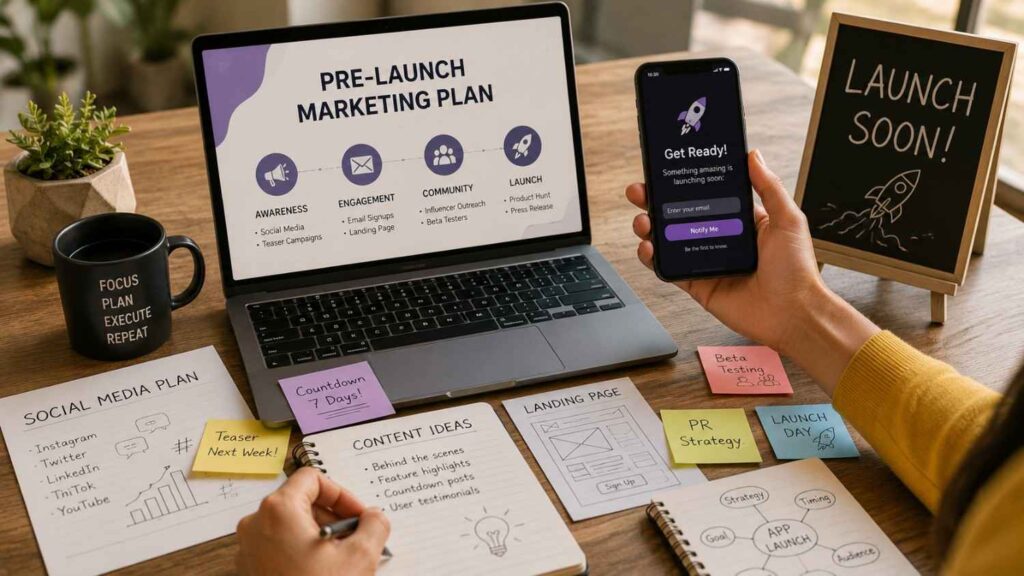
Quick Answer About How to Create a Pre-Launch App Marketing Campaign
To create a pre-launch app marketing campaign, begin by defining the audience, the problem the app solves, and the primary action you want potential users to take. That action may be joining a waitlist, applying for beta access, placing an App Store pre-order, or completing Google Play pre-registration. Build a focused landing page that explains the product clearly, captures qualified interest, and allows every acquisition channel to be measured.
Next, recruit representative beta testers and collect structured feedback about usability, onboarding, messaging, and technical performance. Prepare accurate app store listings with a clear icon, screenshots, descriptions, privacy information, and promotional assets. Publish useful content that educates the audience about the problem before increasing direct promotional activity.
Create an email sequence that moves subscribers from initial interest to launch-day action. Track campaign sources with campaign links, UTM parameters, analytics events, and store performance reports. Align every marketing milestone with product readiness so the campaign does not promise unfinished features or an unrealistic release date.
The most effective pre-launch app marketing campaign builds both demand and knowledge. It gives the team an early audience while revealing which messages, channels, features, and onboarding experiences are most likely to support a successful public release.
Define the Campaign’s Main Objective
A pre-launch campaign should have one clearly defined primary objective. Without that focus, teams often collect many disconnected metrics—followers, website visits, likes, email addresses, and beta applications—without knowing which outcome actually represents progress toward launch.
The primary objective should reflect the app’s current stage. An early prototype may need qualified beta testers who can help validate the experience. A nearly finished consumer app may focus on waitlist registrations, App Store pre-orders, or Google Play pre-registration. A business app may prioritize demo requests, pilot customers, or conversations with decision-makers.
Choose one main conversion and identify supporting metrics that explain how users reach it. For example, if the objective is waitlist growth, supporting measures might include landing-page conversion, traffic source, email confirmation rate, and subscriber engagement.
A focused objective also improves messaging. A beta-recruitment campaign can emphasize participation and influence, while a pre-order campaign should emphasize the product’s value and expected release. The campaign becomes easier to evaluate because every channel, creative asset, and call to action supports the same result.
| Marketing Channel | Primary Goal | Best Used During |
|---|---|---|
| Landing Page | Collect waitlist signups | Early campaign |
| Email Marketing | Nurture interested users | Throughout campaign |
| Beta Testing | Validate product and gather feedback | Mid campaign |
| Social Media | Build awareness and engagement | Entire campaign |
| Influencer Marketing | Reach targeted audiences | Final weeks before launch |
| App Store Pre-Orders / Pre-Registration | Capture launch intent | Before release |
| Content Marketing | Educate and build trust | Early to mid campaign |
| PR & Media Outreach | Increase credibility and visibility | Launch preparation |
Connect Marketing With Product Readiness
Marketing and product development should operate as one coordinated process throughout the pre-launch period. When these teams work separately, promotional content may describe features that are incomplete, communicate outdated positioning, or announce a date that the development team cannot confidently support.
Create a shared launch calendar that includes product milestones, beta releases, app store submission work, privacy reviews, content production, creator outreach, email campaigns, customer-support preparation, and release decisions. Each marketing activity should depend on an appropriate level of product readiness.
For example, broad creator outreach should not begin while the onboarding flow changes every few days. Store screenshots should not be finalized before the interface is stable. Launch-day email scheduling should remain flexible until store approval and release controls are understood.
Product feedback should also influence marketing. Beta testers may describe the app’s value differently from the original campaign language. Their questions can reveal missing explanations, while their behavior may identify the feature that deserves the strongest emphasis.
Connecting both functions reduces reputational risk and improves the campaign. Marketing generates evidence about demand, while product development ensures that the experience can support the promises being made.
How to Create a Pre-Launch App Marketing Campaign
Learning how to create a pre-launch app marketing campaign involves much more than publishing a few social media posts before release. A professional campaign builds qualified demand, validates product positioning, prepares the app store presence, and gives the product team useful evidence before a large audience arrives.
The pre-launch period is the first opportunity to test whether potential users understand the app’s purpose. A campaign can reveal which audience segments respond most strongly, which benefits motivate action, and which objections prevent people from joining a waitlist or beta program. These insights are valuable because they can improve both marketing and product decisions before acquisition costs increase.
A successful campaign also creates a clear next step. Interested users should not be asked only to “follow for updates.” They should be invited to join a relevant waitlist, request beta access, pre-order the app, pre-register through Google Play, or participate in another measurable activity.
Timing matters. Beginning too late may leave the team without an audience, content library, or validated message when the app becomes available. Beginning too aggressively before the product is stable may create disappointment, missed deadlines, and negative first impressions.
The strongest pre-launch app marketing plans develop in stages. Early activity focuses on audience research and problem awareness. The middle stage introduces product proof, beta participation, and store preparation. The final stage increases promotional intensity, provides launch details, and prepares users to install or activate the app.
The framework below explains how to define positioning, build a conversion funnel, recruit testers, optimize app store assets, create content, work with creators, measure performance, and complete the final release review.
Define Your Audience, Positioning, and Campaign Goals
Before selecting channels or producing promotional assets, define who the app is designed to help and what meaningful outcome it delivers. A campaign aimed at “everyone who uses a smartphone” cannot provide the level of relevance required to attract qualified early users. Even apps with broad potential usually begin by solving a specific problem for a more focused group.
Audience definition affects every later decision. It influences the language used on the landing page, the examples shown in app store screenshots, the communities selected for outreach, and the creators chosen for partnerships. It also determines which objections the campaign must address. A security-conscious business buyer, for example, evaluates an app differently from a consumer searching for a convenient lifestyle tool.
Positioning translates this audience knowledge into a clear market message. It explains the product category, the problem, the promised result, and the reason users should believe the app can deliver that result. Good positioning does not attempt to describe every feature. It establishes the main reason someone should pay attention.
Campaign goals then connect positioning with measurable execution. A useful goal includes an audience, action, timeframe, and success standard. Instead of saying “build awareness,” the team might aim to generate a defined number of qualified waitlist registrations from specific channels before the beta closes.
When these foundations are clear, the rest of the campaign becomes more efficient. Content, advertising, outreach, email, and app store assets reinforce the same message rather than presenting different versions of the product.
Develop a Focused User Persona
A useful user persona should be based on evidence rather than imagination. Begin with customer interviews, prototype tests, competitor reviews, community discussions, search queries, support conversations, industry reports, or responses to an early concept page. These sources reveal how potential users describe their problems and which alternatives they currently use.
The persona should explain the user’s situation, desired outcome, frustration, existing solution, objections, and trigger for seeking a new product. Include only details that affect marketing or product decisions. Demographic information has limited value unless it changes the need, message, channel, or purchasing behavior.
For example, a persona for a team-collaboration app might describe an operations manager coordinating distributed employees through spreadsheets and messaging tools. The important information is not simply age or location. It is the workflow problem, cost of the current approach, authority to adopt software, and reason the manager would consider switching.
Avoid creating too many personas during the first campaign. Start with one primary segment and add secondary versions only when they require meaningfully different positioning or acquisition channels. A focused persona helps the team write clearer headlines, choose better examples, recruit more relevant beta testers, and evaluate whether campaign traffic represents genuine potential users.
Write a Clear Value Proposition
The value proposition should explain what the app helps the user achieve and why the solution is worth trying. It should lead with the desired result rather than a list of technical functions. Features matter, but users usually evaluate them through the benefit they create.
A practical structure is:
For [target user] who needs [job or outcome], [app name] is a [product category] that delivers [main benefit] because [credible differentiator].
This internal statement can then be translated into a shorter headline and supporting copy. For example, a budgeting app should not lead only with “automated categorization and real-time synchronization.” It may communicate that users can understand daily spending without manually maintaining a spreadsheet.
The claim must remain accurate. Avoid describing the product as the fastest, easiest, safest, or most advanced unless the team can support that statement. Early campaigns should build trust rather than depend on exaggerated promises.
Test several versions through interviews, landing-page experiments, advertisements, email subject lines, or beta-recruitment messages. Evaluate not only which option attracts more clicks, but which attracts the right users. A high-performing headline that creates incorrect expectations can damage onboarding and retention.
The strongest value proposition is specific enough to be memorable, broad enough to support future features, and accurate enough to match the real experience.
Related Articles
Build a Pre-Launch Landing Page and Waitlist Funnel
A pre-launch landing page gives the campaign a central and measurable destination. Social posts, advertisements, articles, creator content, public relations, podcasts, webinars, and community outreach should direct interested users toward one page where they can understand the product and take a defined action.
The page does not need to be large. In many cases, a focused single-page experience converts better than an unfinished website filled with vague company information. It should answer three questions quickly: What is the app? Who is it for? Why should someone take action before release?
The landing page also creates an environment the team controls. Social platforms may limit reach, change features, or provide incomplete audience data. An owned page allows the campaign to test messages, capture permission-based contact information, and connect traffic sources with registrations.
For teams building a structured launch plan, this pre-launch marketing checklist provides additional guidance on coordinating waitlists, messaging, and promotional activities before release.
The waitlist funnel begins when the visitor arrives and continues through confirmation, nurturing, beta invitations, launch reminders, and post-release onboarding. A large list alone does not prove that demand is strong. The quality of the subscribers, their source, and their ongoing engagement are more informative than the total number.
The funnel should set realistic expectations. Explain whether subscribers will receive beta access, product updates, a release notification, or a special offer. Do not imply that joining guarantees a feature, discount, or early-access position unless the team intends to provide it.
A well-designed funnel turns anonymous interest into a measurable relationship. It also gives the marketing team a reliable audience that can be segmented, surveyed, and activated when the app becomes available.
Create a Conversion-Focused Landing Page
A conversion-focused landing page should communicate the app’s purpose before asking the visitor to study detailed features. Use a clear headline, a short supporting statement, accurate product visuals, a small number of benefits, and one primary call to action.
The headline should reflect the value proposition rather than simply announce that an app is “coming soon.” The supporting copy can explain the target user, the problem, and the expected outcome. Screenshots, prototypes, or short demonstrations should show the real interface whenever possible. Avoid unrelated stock images that do not help visitors understand the experience.
Each section should support a decision. Benefits can explain what becomes easier, faster, clearer, or more reliable. A short “how it works” section may reduce uncertainty. Credibility can come from founder expertise, beta feedback, pilot customers, media coverage, privacy information, or clearly labeled testimonials.
Do not fabricate reviews or imply that unfinished features already exist. If images represent a prototype, ensure they do not create misleading expectations.
The registration form should request only information that the campaign can use. An email address may be sufficient for a consumer app. A business product may need role, company size, or use case for qualification. Every additional field creates friction, so the value of the information should justify the lower completion rate.
Design the Waitlist and Email Sequence
The waitlist experience begins immediately after registration. Send a confirmation that acknowledges the action, explains what happens next, and gives the subscriber a reason to remain engaged. If email confirmation is required, make that step clear and easy to complete.
A useful pre-launch sequence can include:
- The problem and product vision
- A practical insight related to the category
- A development update or product preview
- An invitation to join the beta
- A demonstration of an important workflow
- Answers to common objections
- A launch-date announcement
- A final reminder with direct store links
The sequence should move users from curiosity toward informed intent. Do not send repetitive messages that say only that the product is launching soon. Each email should provide new information, demonstrate progress, or request a meaningful action.
Segment subscribers when the difference affects the message. Android and iOS users may need different store links. Beta applicants require different instructions from general waitlist members. Business users may need security or integration information that consumer users do not.
Track delivery, confirmation, clicks, replies, unsubscribes, beta applications, and launch actions. These signals reveal whether the campaign is attracting genuinely interested users and whether the product story remains relevant over time.
Validate the Product and Message Through Beta Testing
Beta testing is both a product-development process and a marketing-learning opportunity. It allows representative users to interact with the app before the public launch, helping the team identify crashes, confusing workflows, missing instructions, device-specific problems, and differences between the marketing promise and the actual experience.
Apple provides TestFlight for distributing beta versions and collecting tester feedback. Google Play offers internal, closed, and open testing options, allowing Android developers to control access according to the stage of the product. Google Play’s pre-launch reporting tools may also help identify certain compatibility, stability, performance, and accessibility issues. Automated reports are useful, but they cannot reproduce every real user, device, environment, or workflow.
The beta should have a defined purpose. An early technical beta may focus on stability and device compatibility. A later marketing or usability beta may evaluate onboarding, perceived value, feature understanding, and willingness to return. Trying to test everything at once can produce vague feedback and make prioritization difficult.
The campaign should explain what testers are joining. Provide the expected duration, supported platforms, known limitations, data-handling practices, communication channels, and feedback expectations. If testers receive compensation, free access, or another incentive, communicate it clearly.
Beta activity can also strengthen the launch audience. Testers who see their feedback acknowledged may become credible advocates, reviewers, or referral sources. However, advocacy should emerge from a positive experience rather than pressure.
A structured beta reduces launch risk while giving the team language, examples, questions, and evidence that can improve the public campaign.
Recruit the Right Beta Testers
The quality of beta testers matters more than the total number. Friends, colleagues, and other developers may be helpful for identifying obvious technical issues, but they may not represent the intended customer or behave like a first-time user.
Recruit participants who match the primary persona, use relevant devices, and experience the problem the app is designed to solve. Potential sources include the waitlist, customer interviews, professional communities, niche forums, existing clients, social audiences, industry newsletters, and selected creators.
The recruitment message should explain what the app does, who the program is for, what testers will be asked to complete, and how long participation may take. Mention known limitations so participants do not mistake a beta build for a finished product.
Collect enough profile information to evaluate whether the applicant fits the test. This may include platform, device, role, use case, experience level, or current alternative. Do not collect personal information that is unnecessary for the program.
A smaller group that completes realistic tasks often produces more valuable evidence than a large list of inactive users. Monitor activation, task completion, feedback quality, and repeat use. If a segment does not engage, determine whether the problem is recruitment, instructions, onboarding, or product relevance.
Build a Structured Feedback Loop
Unstructured questions such as “Do you like the app?” rarely produce actionable information. Create a feedback process that connects each response with a workflow, goal, or decision.
Give testers specific tasks and ask what they expected, where they hesitated, whether they completed the task, and what prevented success. Combine surveys with analytics, session observations, interviews, crash reports, support conversations, and in-app feedback. What users do may differ from what they remember or report.
Organize feedback into categories such as technical defects, usability issues, onboarding questions, messaging gaps, feature requests, performance concerns, and policy or privacy questions. Prioritize each item according to severity, frequency, impact on the core value proposition, and effort required.
Not every request should become a feature. A request may represent a rare preference, an onboarding problem, or a misunderstanding created by campaign language. Investigate the underlying need before changing the roadmap.
Close the feedback loop. Tell testers which issues were resolved, what remains under review, and when a new build is available. This demonstrates respect for their contribution and encourages more thoughtful participation.
The final beta review should compare the marketing promise with the observed experience. If users join for one benefit but value another, the positioning may need revision before the public launch.
Optimize Your App Store Presence Before Release
The app store product page is one of the most important conversion points in the campaign. It is where awareness from an advertisement, article, email, search result, creator recommendation, or social post becomes a pre-order, pre-registration, or download.
The store listing should continue the same promise used throughout the campaign. When the advertisement emphasizes one benefit but the product page focuses on unrelated features, users may question whether they reached the correct app. Consistent positioning reduces uncertainty and helps visitors understand the product quickly.
Preparation should begin before submission. The team needs a final or near-final app name, icon, subtitle or short description, long description, screenshots, previews, category selection, support links, privacy details, and any market-specific assets. These elements may require design, writing, review, localization, legal input, and product verification.
Accuracy matters. Screenshots should represent the actual interface and supported functionality. Descriptions should not imply capabilities that are unavailable. Marketing language must also comply with the policies of the relevant store.
App Store Optimization is not limited to keyword selection. It includes the complete conversion experience: search visibility, branding, visual hierarchy, benefit communication, proof, localization, and alignment with acquisition campaigns.
The listing should also be treated as a testable asset. Apple and Google provide tools that may support experiments or audience-specific presentations. Use those tools to test meaningful strategic questions, such as which benefit, screenshot sequence, or visual concept helps qualified visitors understand the app more effectively.
Prepare App Store Optimization Assets
App Store Optimization assets should communicate one coherent product story. Begin with the app name, subtitle or short description, category, and keyword strategy. These elements should be relevant to the product and understandable to the intended user rather than filled with awkward repetitions.
The icon should remain recognizable at small sizes and visually distinct from nearby competitors. Avoid placing detailed text or complex imagery inside an icon that users will often see as a small symbol.
Screenshots should follow a logical sequence. The first images need to communicate the main outcome quickly. Later screenshots can explain important workflows, supporting features, proof, or differentiation. Use readable captions and accurate interface images. Each screenshot should answer a clear question rather than simply display another screen.
App preview videos should demonstrate the product honestly and efficiently. Focus on representative actions and avoid long introductions that delay the useful content.
The written description can explain the problem, benefits, main workflows, important limitations, and reasons to trust the product. Technical details may be valuable, but they should support rather than replace the user outcome.
Localization should adapt meaning, not just language. Search behavior, terminology, screenshots, examples, formatting, and cultural expectations may differ across markets. Review localized assets with people who understand both the language and product category.
Use Pre-Orders, Pre-Registration, and Store Testing
Official pre-release store features can give the campaign a stronger call to action than a general email signup. Apple allows eligible new apps to be published for pre-order through App Store Connect, while Google Play offers pre-registration for qualifying apps before release.
These options capture users inside the store environment, where intent may be stronger because the person can review the official listing. They can also make campaign links more direct. Instead of asking someone to join a separate list and return later, the campaign can send the visitor to the relevant store action.
Use these tools only when the product and release plan are sufficiently reliable. A long delay or unclear launch can reduce trust among users who expected the app to arrive within the communicated timeframe.
Apple’s Product Page Optimization can help developers compare alternate creative assets such as icons, screenshots, or previews. Custom product pages can support audience-specific messaging through unique URLs. These tools can improve alignment between a campaign and the destination page.
Testing should begin with a clear hypothesis. For example, the team may compare an outcome-focused screenshot sequence with a feature-focused sequence. Avoid running experiments only because the tool is available.
Evaluate store activity alongside downstream behavior. A creative variation that increases pre-orders but attracts users who do not activate may not represent a meaningful improvement.
| Pre-Launch Asset | Main Purpose | Suggested KPI |
|---|---|---|
| Landing page | Explain the value proposition | Visitor-to-signup conversion |
| Waitlist email | Nurture early interest | Click, reply, and launch-action rate |
| Beta program | Validate product experience | Active testers and completed workflows |
| App store listing | Convert store visitors | Product-page conversion |
| Pre-order or pre-registration | Capture release intent | Confirmed registrations |
| Creator campaign | Reach trusted audiences | Qualified visits and registrations |
| Educational content | Build problem awareness | Engaged traffic and assisted conversions |
| Store experiment | Improve creative performance | Incremental conversion lift |
Create a Content, Community, and Influencer Plan
Pre-launch content should help the audience understand the problem, category, and product before repeatedly asking for a download that is not yet available. A campaign that publishes only countdowns and feature announcements may struggle to maintain interest, especially when the release date is several weeks away.
A professional content plan moves through stages. Early content builds problem awareness and demonstrates expertise. Middle-stage content introduces the product, development decisions, beta learning, and use cases. Final-stage content provides stronger proof, launch details, store actions, and onboarding expectations.
The plan should reflect the audience’s preferred formats and communities. A business app may gain more value from LinkedIn posts, newsletters, webinars, case studies, professional groups, or founder-led articles. A consumer app may depend more on short-form video, creator demonstrations, search content, podcasts, or category-specific communities.
Consistency does not require producing an entirely new idea for every channel. One useful insight can become a blog article, email, video, infographic, social post, and discussion prompt. Repurposing allows the team to reinforce the same positioning without publishing identical copy.
Community participation should provide value before promotion. Answer questions, share useful knowledge, and respect group rules. Entering a community only to post a launch link can damage credibility.
Creator and media outreach should also begin with audience relevance. The goal is not simply broad exposure. It is reaching people who understand the problem and are likely to evaluate the app seriously.
A coordinated plan ensures that content, community activity, creator partnerships, and public relations all support the same campaign objective.
Publish Content Across the Launch Timeline
Organize content according to the audience’s level of awareness and the product’s readiness. During the early phase, focus on the problem, common mistakes, industry context, and practical advice. This allows the team to build credibility before asking for registration.
As the product becomes more stable, introduce development stories, product decisions, interface previews, beta observations, workflow demonstrations, and use cases. These assets provide evidence that the app is real and help potential users understand how it fits into their routine.
In the final phase, increase the clarity of calls to action. Publish the release date, supported platforms, store pages, onboarding guidance, pricing information, privacy details, FAQs, and reminders. Use direct links so users do not need to search for the app manually.
Create an editorial calendar with the topic, format, channel, audience stage, owner, production deadline, publication date, and intended action. This prevents last-minute content requests and ensures that every asset supports the launch timeline.
Measure content according to its role. Early educational articles may assist conversions without generating direct registrations. Product demonstrations may have a stronger relationship with beta applications or pre-orders.
Repurpose strong ideas rather than chasing constant novelty. Repetition of a clear strategic message across different formats helps the audience remember the app.
Work With Creators and Media Responsibly
Creator partnerships work best when the creator’s audience, style, and credibility align with the app. A large follower count does not guarantee relevant reach, trust, or conversions. Review the creator’s past content, audience comments, typical engagement, category expertise, and ability to explain products accurately.
Provide a clear brief containing the target user, problem, supported features, approved claims, limitations, launch timing, store links, disclosure requirements, and contact information. Give the creator enough freedom to communicate naturally, but do not encourage statements that the product cannot support.
Material relationships must be disclosed clearly. Payments, free access, gifts, affiliate arrangements, or other incentives may affect how an audience evaluates an endorsement. The Federal Trade Commission provides guidance on disclosures and endorsements for creators and brands.
Track partnerships using campaign-specific links, landing pages, referral codes, or UTM parameters where appropriate. Evaluate qualified registrations, beta participation, pre-orders, activation, and retention—not only views.
Media outreach requires similar relevance. Research the publication and individual journalist before sending a pitch. Explain why the product matters to that audience rather than sending a generic announcement.
Prepare a press kit with the product summary, founder information, launch date, screenshots, logo files, demonstration access, contact details, and supporting evidence. Accuracy and responsiveness are more important than exaggerated claims.
Measure the Campaign and Prepare for Launch Day
A pre-launch app marketing campaign should be measured as a connected funnel rather than a collection of isolated numbers. Reach, impressions, likes, and website traffic show that people encountered the campaign, but they do not prove that the campaign is generating qualified demand.
Map the expected journey from first contact to landing-page visit, registration, beta application, store action, install, onboarding, activation, and retention. Some later metrics will not be available until launch, but the event structure and reporting plan should be prepared in advance.
Each metric needs a purpose. Awareness measures show whether the campaign is reaching the intended audience. Consideration measures show whether people want to learn more. Intent measures indicate whether users are taking actions associated with release. Post-launch metrics determine whether the acquired users actually receive value.
Attribution also needs planning. Campaign links, UTM parameters, referral codes, analytics events, and store reports can help the team understand which sources contribute to performance. No attribution model is perfect, so combine quantitative data with surveys, interviews, and customer responses.
A well-planned pre-launch app marketing strategy also emphasizes validating campaign performance before launch so marketing decisions are supported by real user signals rather than assumptions.
Launch readiness extends beyond marketing. Store approval, privacy information, support workflows, analytics, pricing, onboarding, infrastructure, and incident communication must be prepared. A successful promotional campaign can create a serious product problem if the team cannot support the resulting users.
The final review should therefore examine both demand and delivery. The team needs confidence that the campaign can direct users to the correct destination and that the app can provide the experience that was promised.
Choose Metrics That Match Each Stage
Awareness metrics may include qualified reach, video completion, content engagement, branded search activity, podcast mentions, or relevant website visits. These measures help determine whether the campaign is reaching the intended market rather than a broad but uninterested audience.
Consideration metrics include landing-page conversion, time spent with product content, email confirmation, email clicks, survey responses, beta applications, product-page views, and return visits. They show whether the audience is actively evaluating the app.
Intent metrics include pre-orders, pre-registration, beta activation, calendar reminders, direct replies, referral activity, and clicks on launch links. After release, connect these actions with installs, onboarding completion, account creation, first-value events, trials, subscriptions, and early retention.
Define each metric before the campaign starts. For example, an “activated beta tester” may mean someone who completes onboarding and one core workflow, not merely someone who installs the build.
Apple campaign links, Google Analytics UTM parameters, store acquisition reports, and product analytics can help connect sources with outcomes. Maintain consistent naming so reports do not split the same channel into several labels.
Avoid optimizing only for the cheapest registration. A channel that produces more expensive but better-retained users may be more valuable than one that generates a large inactive list.
Review metrics together. Conversion, activation, and retention provide a more complete picture than any single number.
Complete a Final Launch-Readiness Review
The final launch-readiness review should confirm that marketing, product, operations, support, analytics, and leadership are working from the same plan. Conduct the review before the campaign reaches its highest promotional intensity.
The checklist should cover:
- Final app build and supported devices
- Store approval and release controls
- Product-page metadata and creative assets
- Privacy disclosures and permission explanations
- Website and download links
- Email scheduling and segmentation
- Creator and media publication dates
- Customer-support ownership and response templates
- Crash, performance, and infrastructure monitoring
- Analytics events and attribution links
- Pricing, subscriptions, and purchase flows
- Status-page or incident communication
- Contingency plans for delays or technical issues
Test every public link on the devices and platforms users will use. Confirm that email buttons lead to the correct store. Check that campaign parameters are recorded and that important product events appear in analytics.
Prepare a decision process for delaying or limiting the release. If a serious technical, policy, or store-review problem appears, the team should know who has authority to change the plan.
Do not continue promoting an exact date when confidence has fallen. A clear and timely update protects trust more effectively than silence, broken links, or an app that cannot support the users the campaign attracted.
Frequently Asked Questions About How to Create a Pre-Launch App Marketing Campaign
Planning a pre-launch app campaign often raises practical questions about timing, budgets, landing pages, beta programs, store tools, and performance measurement. The correct answer depends on the app’s category, development stage, audience, business model, and available resources.
A simple consumer utility may require a shorter campaign than a regulated business platform with complex onboarding. A startup with an established community may activate an existing audience, while a new team may need more time to build credibility and collect early subscribers.
The most important principle is alignment. Marketing activity should increase as the product, store listing, support process, and release plan become more reliable. Teams should avoid creating broad demand for a product that cannot yet deliver the promised experience.
Another common mistake is focusing entirely on the total number of registrations. A smaller group of engaged users who complete beta tasks, open emails, and understand the product may be more valuable than a large list attracted by an unrelated giveaway.
The questions below address the most common search intents from founders, developers, product managers, and marketers. Each answer should be adapted to the app’s specific risk, audience, market, and launch objective.
When Should Pre-Launch App Marketing Begin?
Foundational pre-launch work should begin as soon as the team has a credible understanding of the target user, problem, and product direction. Audience research, positioning, competitor analysis, domain setup, and landing-page planning can begin before the final app is complete.
Public promotional activity should increase gradually. An early-stage product may focus on interviews, concept testing, and beta recruitment. A more stable build can support demonstrations, creator previews, app store preparation, and broader waitlist acquisition.
The timeline may range from several weeks to several months depending on product complexity, market education, store requirements, and audience size. A business app with a long evaluation process may need more lead time than a simple consumer tool.
Do not begin a highly visible countdown before the team has confidence in the product and release path. Changing a date is sometimes necessary, but repeated delays can reduce trust.
Use product milestones rather than an arbitrary calendar as the main guide. The campaign should become more specific and promotional as onboarding stabilizes, beta issues decline, store assets are finalized, and operational readiness improves.
Starting early does not mean promoting aggressively from the beginning. It means building the audience, evidence, and systems needed for a responsible launch.
Does Every App Need a Pre-Launch Landing Page?
Most apps benefit from a pre-launch landing page because it gives the campaign a controlled destination before or alongside the official store listing. The page can explain the value proposition, capture email interest, recruit beta testers, answer common questions, and measure traffic from different channels.
The page does not need to become a full corporate website. A focused page with a clear headline, accurate visuals, key benefits, credibility, and one call to action may be sufficient.
A landing page is particularly useful when the app store page is not yet live, when the campaign needs information beyond a store action, or when different audience segments require qualification. Business apps may collect role and company information, while consumer apps may need only an email address and platform preference.
Some campaigns can direct users immediately to an App Store pre-order or Google Play pre-registration page. Even then, an owned landing page can provide additional context, support search visibility, host media resources, and collect users who are not ready to take the store action.
The page should be maintained. Remove outdated screenshots, incorrect dates, unsupported claims, and broken links. A neglected page can damage confidence.
A simple and accurate landing page is usually more useful than a large but incomplete website.
How Many Beta Testers Should an App Recruit?
There is no universal number of beta testers that guarantees a successful launch. The required group depends on the number of supported devices, user segments, workflows, regions, languages, operating-system versions, and risks.
Begin with a smaller controlled group that allows the team to respond quickly. Expand the beta when the build becomes more stable and the feedback process can support additional participants. A staged approach helps prevent the team from receiving the same obvious issue from hundreds of users.
Coverage matters more than raw size. The program should include representative users, relevant device types, expected experience levels, and the most important use cases. A business app may need participants from different roles, while a consumer app may need coverage across platforms and device capabilities.
Track active participation rather than invitations. A tester who installs the app but never completes onboarding provides limited evidence. Define meaningful participation through completed workflows, sessions, feedback, or repeat use.
The team should also have enough capacity to review reports, communicate updates, and support participants. Recruiting more testers than the team can manage may create frustration and low-quality data.
A smaller, engaged, and representative group is usually more valuable than a large inactive beta list.
Should I Use App Store Pre-Orders or Google Play Pre-Registration?
App Store pre-orders and Google Play pre-registration can be valuable when the app is eligible, the listing is ready, and the release plan is credible. These tools allow users to take an official store-based action before public availability.
They can represent stronger intent than a general email signup because the user has reached the product page and chosen a release-related action. Store links may also reduce friction in advertisements, creator content, emails, and media coverage.
However, these tools should not replace the broader campaign. Users may still need education, product demonstrations, beta opportunities, reminders, and onboarding information. A pre-order or pre-registration count does not guarantee activation or retention.
Use an external waitlist when the campaign needs richer segmentation, surveys, beta recruitment, or direct communication. Many teams use both an owned email list and official store actions.
Before enabling either option, verify the current eligibility, scheduling, metadata, and release requirements in the relevant developer documentation. Store rules and product features can change.
Most importantly, avoid opening pre-orders or pre-registration before the team has reasonable confidence in the product. Capturing demand too early can create disappointment if the release is delayed or the final experience differs significantly from the listing.
How Much Should a Pre-Launch Campaign Cost?
The appropriate budget depends on the audience, app category, geographic market, creative requirements, competition, business model, and available internal skills. There is no single amount that fits every launch.
Begin by separating essential infrastructure from optional amplification. Essential costs may include landing-page hosting, design, app store assets, analytics, beta support, legal or privacy review, email infrastructure, and content production. Paid advertisements, creator partnerships, public relations, events, and specialized tools may be added according to the strategy.
Use small tests before committing a large budget to an acquisition channel. Measure qualified registrations, beta participation, pre-orders, activation, and early retention rather than choosing a channel based only on low click costs.
Reserve part of the budget for the period after launch. Spending everything before release can leave the team unable to support successful creative assets, respond to new opportunities, or improve weak onboarding.
Internal time should also be treated as a cost. A low-cost channel may require significant founder, design, or community-management effort.
Build the budget from campaign objectives and expected activities rather than copying another company’s spending level. The best budget is one the team can measure, manage, and adjust without depending on unrealistic conversion assumptions.
What Is the Most Important Pre-Launch Metric?
The most important metric is the action that best represents qualified launch intent for the specific campaign. That may be a waitlist registration, active beta participation, App Store pre-order, Google Play pre-registration, pilot request, or another meaningful conversion.
The metric should be close enough to the business objective to guide decisions. Social engagement may help explain awareness, but it is usually not the primary success measure unless the campaign’s goal is specifically community growth.
Quality matters. A waitlist subscriber who fits the target audience, opens product updates, and clicks the launch link is more valuable than a registration generated through an unrelated incentive. An active beta tester may provide more value than several passive subscribers.
Supporting metrics should explain the funnel. Track source, landing-page conversion, email confirmation, beta activation, store-page activity, and eventual app activation. These measures show where potential users lose interest or encounter friction.
After launch, validate the pre-launch metric against real product behavior. Determine whether the channels and actions associated with early intent produced users who completed onboarding, reached the first-value event, and returned.
The most useful metric is therefore not simply the largest number. It is the measure that predicts meaningful product use and helps the team improve campaign decisions.
Conclusion
A successful pre-launch app marketing campaign combines audience development with product validation. It builds awareness before release, but it also helps the team refine positioning, improve onboarding, test creative assets, and prepare operational systems.
The process begins with a focused audience, a credible value proposition, and one primary campaign objective. A landing page and waitlist funnel then convert anonymous interest into a measurable relationship. Beta testing helps confirm that the app can deliver the promised value, while app store preparation ensures that campaign traffic reaches a clear and accurate destination.
Content, community participation, creator partnerships, and media outreach can expand demand when they are relevant to the target audience. These activities should educate and demonstrate rather than rely only on repeated launch announcements.
Measurement connects the campaign together. Awareness metrics indicate reach, consideration metrics reveal interest, and intent metrics show whether users are preparing to act. Post-launch activation and retention determine whether the pre-launch campaign attracted people who genuinely benefit from the product.
Teams should also prepare for uncertainty. Store review, technical issues, infrastructure problems, or product changes may affect the release. Clear ownership and contingency planning protect the audience relationship when conditions change.
Learning how to create a pre-launch app marketing campaign is ultimately about coordinating market demand with product readiness. The campaign should not create attention faster than the app can earn trust. When the marketing promise, store listing, onboarding flow, and product experience align, early users are more likely to activate, remain engaged, and recommend the app.
Build Demand and Learning at the Same Time
The strongest pre-launch campaigns treat every marketing activity as both promotion and research. A landing-page test reveals which value proposition attracts qualified users. A beta invitation shows which audience segments are willing to invest time. A creator partnership can reveal whether a particular community understands the product quickly.
This learning should be documented and shared across marketing, product, design, and leadership. Do not evaluate only the total number of clicks or registrations. Record the questions users ask, the benefits they repeat, the features they misunderstand, and the objections that prevent action.
Use this evidence to improve the product story. If testers consistently describe the app differently from the campaign, investigate whether their language is clearer. If one channel generates more engaged users, determine what that audience has in common.
Demand and learning should increase together. A rapidly growing waitlist provides limited value when the team does not understand why people joined or whether they represent the intended market.
The campaign should become more confident as evidence improves. Early messages can remain exploratory. Later campaigns should use validated positioning, accurate demonstrations, and proof from real testing.
This approach reduces waste and allows the launch to reflect what users have actually shown, not only what the team originally assumed.
Prepare for the Experience After the Install
Launch-day installs are not the final objective. The app must help new users understand the product, complete onboarding, reach an early success moment, and know where to find support.
Review the complete journey from the campaign message to the first in-app experience. If an advertisement promises quick expense tracking, onboarding should guide the user toward that result without unnecessary steps. If a creator demonstrates a particular workflow, the user should be able to find it easily after installation.
Prepare welcome messages, help content, FAQs, support ownership, analytics events, and recovery paths for common errors. Monitor crashes, failed registrations, payment problems, permission confusion, and points where users abandon onboarding.
Connect acquisition reports with activation and retention. A campaign channel that produces many installs but few successful users may need different targeting or messaging. A smaller source that produces strong activation may deserve more investment.
Communicate with early users after launch. Share important fixes, request focused feedback, and acknowledge problems honestly. Early supporters often tolerate minor issues when the team responds clearly and demonstrates progress.
The pre-launch campaign creates an expectation. Long-term growth depends on the product fulfilling that expectation. Marketing and product teams should therefore continue collaborating after release rather than treating launch day as the end of the campaign.