
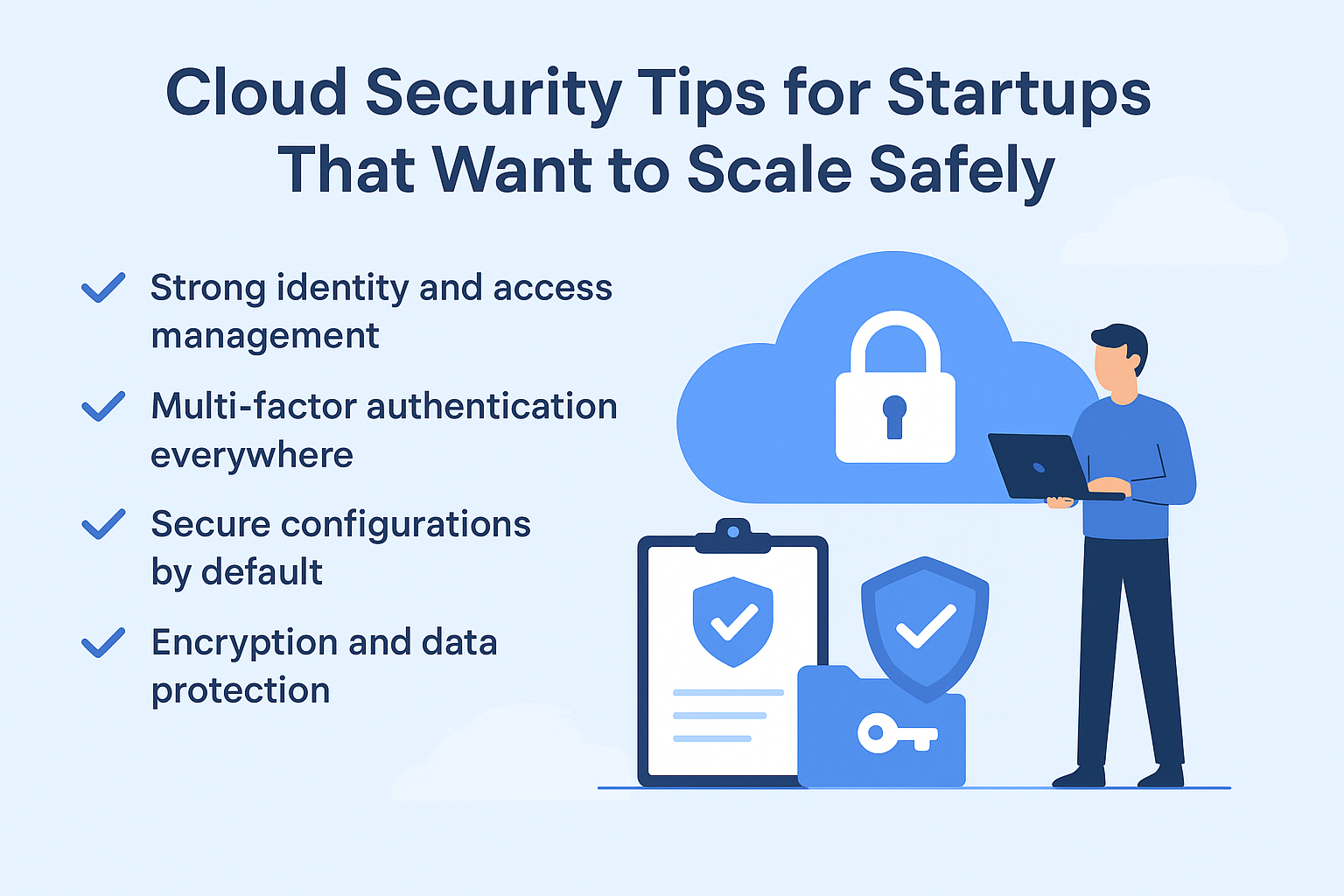
Introduction: Why Cloud Security Tips Matter for Startups
Cloud computing has become the backbone of modern startups. From hosting applications to storing customer data, startups rely heavily on cloud platforms like AWS, Google Cloud, and Microsoft Azure to move fast and scale efficiently. However, this rapid adoption also introduces serious risks. Cloud security tips for startups are no longer optional—they are essential for survival.
Startups are attractive targets for cybercriminals. According to industry reports, over 40% of cyberattacks target small businesses and startups, largely because they often lack mature security practices. Many founders assume cloud providers handle security entirely, but this is a dangerous misconception. While cloud platforms secure the underlying infrastructure, startups are responsible for securing their data, users, and configurations.
Poor cloud security can lead to:
- Data breaches exposing customer information
- Financial losses from downtime or ransomware
- Loss of customer trust and brand damage
- Failed investor due diligence or delayed funding rounds
For example, a well-known startup once exposed millions of user records simply due to a misconfigured cloud storage bucket. There was no sophisticated hacking involved—just a lack of basic cloud security controls. This highlights why following proven cloud security best practices for startups is critical, even at the earliest stages.
This guide is designed to provide practical, easy-to-follow cloud security tips for startups, regardless of size or technical maturity. You’ll learn:
- What cloud security actually means for startups
- The most common cloud security risks
- Actionable cloud security best practices
- Tools, strategies, and mistakes to avoid
Whether you’re a solo founder, CTO, or early engineering hire, this article will help you secure your cloud environment without slowing down growth.
Key takeaway: Strong cloud security is not about expensive tools—it’s about smart decisions, visibility, and consistency.
Cloud security refers to the policies, technologies, controls, and best practices used to protect data, applications, and infrastructure hosted in the cloud. For startups, cloud security is about keeping customer data safe, preventing unauthorized access, and ensuring systems remain available and trustworthy as the business grows.
Unlike traditional on-premise security, cloud security is dynamic and shared. This means responsibility is split between the cloud provider and the startup using the platform. Understanding this shared responsibility model is one of the most important cloud security tips for startups.
At its core, cloud security focuses on three fundamental goals, often called the CIA triad:
| Principle | What It Means for Startups |
|---|---|
| Confidentiality | Only authorized users can access sensitive data |
| Integrity | Data remains accurate and unaltered |
| Availability | Systems and data are accessible when needed |
If any of these fail, startups risk outages, breaches, or compliance violations.
What Does Cloud Security Include?
Cloud security is not a single tool or setting. It is a collection of layers, each protecting a different part of your cloud environment.
Key components of cloud security for startups include:
- Data security
- Encrypting sensitive customer and business data
- Protecting backups and storage systems
- Identity and access management (IAM)
- Controlling who can access what in the cloud
- Preventing excessive permissions
- Network security
- Securing cloud networks, firewalls, and endpoints
- Limiting exposure to the public internet
- Application and API security
- Protecting cloud-hosted apps and integrations
- Securing authentication and APIs
- Monitoring and logging
- Tracking activity across cloud resources
- Detecting suspicious behavior early
- Compliance and governance
- Meeting industry and regulatory requirements
- Maintaining audit-ready cloud environments
Each of these areas plays a role in building a secure cloud foundation. Ignoring even one can create a serious security gap.
How Cloud Security Works in Startup Environments
Startups typically operate in lean, fast-moving cloud environments. Infrastructure changes frequently, new tools are added, and teams grow quickly. This makes cloud security both more challenging and more important.
Most startups rely on the Shared Responsibility Model, which looks like this:
| Cloud Provider Secures | Startup Secures |
|---|---|
| Physical data centers | User access and permissions |
| Hardware and networking | Cloud configurations |
| Core infrastructure | Data, applications, APIs |
| Platform availability | Compliance and monitoring |
For example:
- AWS secures the physical servers
- Your startup must secure the S3 bucket permissions
This model explains why so many breaches happen without hackers ever breaking in. Misconfigurations and human error account for the majority of cloud security incidents.
Important insight: Cloud platforms are secure by design, but insecure by default if not configured correctly.
Why Cloud Security Is Different from Traditional Security
Traditional security relied heavily on perimeter defenses like firewalls. Cloud security is different because:
- There is no fixed network perimeter
- Users access systems from anywhere
- Infrastructure is software-defined and constantly changing
This is why modern cloud security tips for startups emphasize:
- Zero trust access
- Automation
- Continuous monitoring
- Least-privilege permissions
Startups that treat cloud security as a one-time setup often fall behind. Security must evolve as the company scales.
Simple Cloud Security Example (Startup Scenario)
Imagine a SaaS startup storing customer data in the cloud:
- The database is encrypted ✅
- Access is limited to specific roles ✅
- Activity is logged and monitored ✅
Now compare that to an insecure setup:
- Database exposed to the internet ❌
- Shared admin credentials ❌
- No monitoring or alerts ❌
The difference between these two scenarios is not budget—it’s awareness and implementation of basic cloud security best practices.
## Why Startups Face Unique Cloud Security Challenges
Startups operate very differently from large enterprises, and those differences create unique cloud security challenges. While the cloud makes it easy to build and scale quickly, it also makes it easy to introduce security risks without realizing it. Understanding these challenges is a critical step in applying the right cloud security tips for startups.
Many security incidents don’t happen because startups ignore security entirely. They happen because startups prioritize speed, growth, and product-market fit—often at the expense of structured security practices.
Limited Budgets and Security Resources
Most startups operate with tight budgets and small teams. There is rarely a dedicated security engineer in the early stages, and security responsibilities often fall to developers or founders who already wear multiple hats.
Common issues include:
- No formal security ownership
- Reliance on default cloud settings
- Delayed investment in security tools
According to cybersecurity surveys, over 60% of startups do not have a defined cloud security strategy in their first two years. This creates blind spots that attackers actively look for.
However, it’s important to note that strong cloud security does not always require expensive tools. Many effective cloud security best practices for startups—such as access control, encryption, and monitoring—are built into cloud platforms at little or no cost.
Reality check: Most startup cloud breaches happen due to misconfigurations, not lack of spending.
Rapid Scaling and Constant Change
Startups scale fast—or at least try to. New features, new users, new integrations, and new cloud resources are added constantly. This rapid pace creates security risks such as:
- Forgotten test environments left exposed
- Old permissions never revoked
- Temporary workarounds becoming permanent
Cloud environments are highly dynamic. A secure setup today can become insecure tomorrow if changes are not monitored and reviewed regularly.
Security debt builds up quickly when speed is prioritized over structure. This is why ongoing monitoring and automation are key cloud security tips for startups that want to scale safely.
Remote Teams and Distributed Access
Remote work is the norm for many startups. While this enables flexibility and global hiring, it also increases the attack surface.
Common risks include:
- Employees accessing cloud systems from unsecured networks
- Personal devices used for work without proper security
- Shared credentials across team members
Without proper controls, one compromised device or account can lead to a full cloud environment breach.
A strong cloud security posture for startups must account for:
- Device security
- Identity-based access
- Location-independent authentication
SaaS Sprawl and Third-Party Integrations
Startups rely heavily on SaaS tools and cloud integrations to move fast. CRM platforms, analytics tools, payment processors, and automation tools all connect to the core cloud infrastructure.
Each integration introduces risk:
- Excessive permissions granted to third-party apps
- Poorly secured APIs
- Lack of visibility into data sharing
In fact, third-party access is one of the fastest-growing cloud security risks. Many startups don’t track which tools have access to their cloud data or how that access is used.
Best practice: Treat every integration as a potential security risk until proven otherwise.
Lack of Cloud Security Awareness
Finally, many startup teams simply don’t know what they don’t know. Cloud security concepts like IAM, encryption, logging, and zero trust are often learned reactively—after a problem occurs.
This leads to:
- Overconfidence in cloud provider security
- Misunderstanding the shared responsibility model
- Delayed response to security incidents
Education and documentation are often overlooked but are essential cloud security tips for startups aiming to reduce human error.
Summary: Why These Challenges Matter
When combined, these challenges create a perfect storm:
- Limited resources
- Fast-moving infrastructure
- Distributed teams
- Complex cloud environments
This is why startups must be intentional and proactive about cloud security from day one. Addressing these challenges early is far easier than fixing them after a breach or failed audit.
Understanding cloud security risks is essential before implementing solutions. Many startups focus on tools first, but effective cloud security tips for startups start with awareness. When you know where the real risks are, you can prioritize the controls that matter most.
Most cloud security incidents fall into a small number of repeatable patterns. These risks are well-documented, preventable, and often caused by configuration mistakes rather than advanced attacks.
What Are the Most Common Cloud Security Threats for Startups?
Below are the most frequent cloud security risks startups face, based on industry breach reports and cloud security research.
1. Cloud Misconfigurations
Cloud misconfiguration is the #1 cause of cloud security breaches.
Examples include:
- Publicly accessible storage buckets
- Databases exposed to the internet
- Open admin dashboards without authentication
A single misconfigured setting can expose millions of records.
Fact: Over 80% of cloud security incidents are caused by misconfiguration or human error.
2. Weak Identity and Access Controls
Startups often grant broad access to move faster. This leads to:
- Shared admin accounts
- Excessive permissions
- Lack of role separation
If one account is compromised, attackers can move freely across the cloud environment.
Identity is the new perimeter in cloud security. Poor IAM practices are one of the most dangerous risks startups face.
3. Credential Theft and Account Takeovers
Cloud environments are prime targets for credential-based attacks.
Common causes include:
- Password reuse across services
- No multi-factor authentication (MFA)
- Phishing attacks targeting startup employees
Once attackers gain access, they often:
- Create new cloud resources
- Exfiltrate data
- Deploy cryptomining workloads
4. Insecure APIs and Integrations
APIs power modern startups, but unsecured APIs create massive risks.
Common API security issues:
- Missing authentication
- Weak access tokens
- No rate limiting
APIs are often exposed to the internet, making them attractive attack vectors.
5. Lack of Visibility and Monitoring
Many startups do not monitor their cloud environments effectively.
This results in:
- Breaches going undetected for weeks or months
- No audit trail during investigations
- Slow incident response
Data point: The average cloud breach takes over 200 days to detect without proper monitoring.
6. Insider Threats (Accidental or Malicious)
Not all threats come from outside the company.
Insider risks include:
- Employees accidentally exposing data
- Former employees retaining access
- Contractors with excessive permissions
Most insider incidents are accidental, but the impact can be severe.
Real-World Cloud Security Failure: A Startup Case Example
Case Study: Misconfigured Cloud Storage
A fast-growing startup stored customer data in a cloud storage bucket. The bucket was mistakenly configured as public during testing and never reverted.
What went wrong:
- No access review process
- No monitoring alerts
- No automated misconfiguration detection
Impact:
- Sensitive user data exposed
- Public trust damaged
- Emergency security audit required
Lesson learned: Basic cloud security checks could have prevented the incident entirely.
Cloud Security Risks by Impact and Likelihood
| Risk | Likelihood | Impact |
|---|---|---|
| Misconfigurations | High | Critical |
| Weak IAM | High | Critical |
| API vulnerabilities | Medium | High |
| Credential theft | Medium | High |
| Insider threats | Low–Medium | High |
This table helps startups prioritize their cloud security efforts based on real-world risk.
Why Startups Must Address These Risks Early
Ignoring cloud security risks doesn’t just increase breach likelihood—it also:
- Raises future compliance costs
- Slows enterprise sales
- Creates friction during funding rounds
Investors increasingly ask about cloud security practices during due diligence. Startups that can clearly explain their approach stand out.
Think of these tips as the security foundation for any startup using the cloud.
1. Use Strong Identity and Access Management (IAM)
Identity and Access Management (IAM) controls who can access your cloud resources and what they can do. Poor IAM is one of the most dangerous cloud security weaknesses in startups.
Best IAM practices for startups include:
- Grant access based on roles, not individuals
- Use the principle of least privilege
- Separate admin, developer, and read-only roles
Principle of Least Privilege:
Users should only have access to what they need—and nothing more.
Role-Based Access Control (RBAC) for Startups
RBAC makes permissions manageable as teams grow.
| Role | Typical Permissions |
|---|---|
| Admin | Cloud configuration, IAM management |
| Developer | Deploy apps, manage services |
| Support | Read-only access to logs |
| Contractor | Time-limited, scoped access |
This approach prevents accidental damage and limits the blast radius of compromised accounts.
2. Enable Multi-Factor Authentication (MFA) Everywhere
MFA is one of the simplest and most effective cloud security tips for startups.
Even if credentials are stolen, MFA blocks unauthorized access.
MFA should be enforced for:
- Cloud console access
- Admin and privileged users
- CI/CD pipelines
- Third-party integrations
Fact: MFA can block over 99% of automated account takeover attacks.
Avoid exceptions. One unprotected admin account can compromise the entire environment.
3. Secure Cloud Data with Encryption
Encryption ensures that even if data is accessed or stolen, it cannot be read.
Encrypt Data at Rest
Most cloud providers offer default encryption for:
- Databases
- Object storage
- Backups
Startups should:
- Verify encryption is enabled
- Manage encryption keys properly
- Restrict access to key management systems
Encrypt Data in Transit
Data in transit must be protected using:
- HTTPS (TLS) for web traffic
- Secure internal service communication
Unencrypted traffic is vulnerable to interception and tampering.
4. Avoid Cloud Misconfigurations
Misconfigurations are responsible for the majority of cloud security incidents.
Common startup misconfigurations:
- Public storage buckets
- Open security groups
- Default credentials left unchanged
How startups can prevent misconfigurations:
- Use infrastructure-as-code (IaC)
- Apply configuration templates
- Run automated security checks
Best practice: Treat cloud configuration like source code—review it, test it, and monitor it.
5. Regularly Monitor and Log Cloud Activity
Visibility is essential for cloud security.
Key logs startups should collect:
- Authentication and access logs
- API calls and configuration changes
- Network traffic logs
Monitoring allows startups to:
- Detect suspicious behavior early
- Investigate incidents quickly
- Meet compliance requirements
Without logging, security incidents often go unnoticed until damage is done.
Summary: Core Cloud Security Tips That Matter Most
| Tip | Security Benefit |
|---|---|
| Strong IAM | Prevents unauthorized access |
| MFA everywhere | Blocks credential attacks |
| Encryption | Protects sensitive data |
| Secure configs | Prevents data exposure |
| Monitoring | Enables early detection |
Startups that implement these cloud security best practices build a resilient and scalable security posture from day one.
Technology alone cannot secure a cloud environment. One of the most overlooked cloud security tips for startups is focusing on people and processes. Many breaches happen not because of weak tools, but because of human error, unclear policies, or lack of awareness.
Startup teams move fast, collaborate often, and rely heavily on shared systems. Without clear security practices, even well-configured cloud environments can quickly become vulnerable.
Train Employees on Cloud Security Basics
Human error is consistently ranked as the leading cause of cloud security incidents. Employees don’t need to be security experts, but they must understand the basics.
Key cloud security topics every startup team should know:
- How phishing attacks work
- Why MFA is mandatory
- How to handle sensitive data
- What to do if something looks suspicious
Simple training can reduce risk dramatically.
Data point: Organizations with regular security awareness training experience up to 70% fewer security incidents.
Training does not need to be complex or expensive. Short sessions, internal documentation, and real-world examples work well for startups.
Create Clear Cloud Security Policies
Security policies provide clarity and consistency. Without them, teams make assumptions that lead to risk.
Essential cloud security policies for startups include:
- Access policy: Who gets access and how it’s approved
- Password policy: Requirements for strong credentials
- Data handling policy: How sensitive data is stored and shared
- Incident response policy: What to do during a security incident
Policies should be:
- Simple
- Easy to follow
- Reviewed regularly
Avoid overcomplicating policies in early stages. Focus on high-impact rules.
Secure Remote Work and Employee Devices
Remote work expands the attack surface. Startup cloud security must extend beyond the cloud console to employee devices.
Best practices for securing remote teams:
- Require device-level security (OS updates, disk encryption)
- Use VPNs or secure access tools
- Restrict access from unknown devices
- Monitor login locations and behavior
If a device is compromised, attackers may gain access to cloud systems through saved credentials or active sessions.
Limit Access for Contractors and Temporary Staff
Startups often rely on contractors, freelancers, and agencies. This introduces additional risk.
Contractor access security tips:
- Grant time-limited access
- Use separate roles or accounts
- Revoke access immediately after work ends
Common mistake: Leaving contractor accounts active after a project is complete.
Access reviews should be performed regularly, especially during team changes.
Encourage a Security-First Culture
Security should not be seen as an obstacle. It should be part of the startup culture.
Ways to promote security awareness:
- Encourage reporting of mistakes without blame
- Share security lessons learned
- Include security in onboarding
When teams feel safe discussing security issues, problems are identified and fixed faster.
Case Example: Security Culture in Action
Scenario:
A startup noticed unusual login alerts in their cloud environment.
What went right:
- An engineer reported the alert immediately
- Access logs were reviewed
- Credentials were rotated quickly
Outcome:
A potential breach was stopped early with no data loss.
Lesson:
A security-aware team is one of the strongest defenses a startup can have.
Summary: Team-Focused Cloud Security Tips
| Area | Best Practice |
|---|---|
| Training | Regular, simple education |
| Policies | Clear and lightweight |
| Remote work | Secure devices and access |
| Contractors | Time-bound permissions |
| Culture | Open and proactive |
Strong cloud security starts with people. When startup teams understand their role in security, technology becomes far more effective.
Choosing the right tools is an important part of implementing effective cloud security tips for startups. The good news is that startups do not need a large security stack to stay protected. Most cloud platforms already include powerful security features, and a small number of well-chosen tools can dramatically improve visibility and control.
The goal is not to buy more tools, but to use the right tools at the right stage.
Built-In Security Tools from Cloud Providers
Major cloud providers offer robust security tools that are often underused by startups. These tools are designed to integrate directly into the cloud environment and are usually cost-effective or free at basic levels.
AWS Cloud Security Tools for Startups
Common AWS security tools include:
- AWS IAM – Manage users, roles, and permissions
- AWS CloudTrail – Log and audit API activity
- AWS GuardDuty – Detect suspicious behavior
- AWS Config – Track configuration changes
- AWS Security Hub – Centralize security findings
These tools help startups:
- Detect unauthorized access
- Identify misconfigurations
- Maintain audit trails
Google Cloud Security Tools
Key Google Cloud security services include:
- Cloud IAM – Identity and access management
- Cloud Audit Logs – Activity and access tracking
- Security Command Center – Risk and vulnerability visibility
- Cloud Armor – DDoS and web application protection
Google Cloud emphasizes default security and automation, which is useful for lean startup teams.
Microsoft Azure Security Tools
Azure offers:
- Azure Active Directory – Identity and access control
- Microsoft Defender for Cloud – Threat detection
- Azure Monitor – Logging and alerts
- Azure Policy – Enforce security rules
Azure security tools integrate well with compliance and enterprise requirements, which helps startups preparing to scale.
Third-Party Cloud Security Tools for Startups
While built-in tools are essential, third-party tools can fill important gaps, especially as startups grow.
Cloud Security Posture Management (CSPM) Tools
CSPM tools continuously scan cloud environments for:
- Misconfigurations
- Compliance violations
- Risky permissions
Benefits for startups:
- Automated security checks
- Reduced human error
- Faster detection of issues
CSPM tools are especially valuable for teams managing multiple cloud services.
Identity and Access Management Tools
Third-party IAM tools help startups:
- Centralize user access
- Enforce MFA consistently
- Manage lifecycle events (onboarding/offboarding)
These tools reduce the risk of orphaned accounts and excessive permissions.
Monitoring and Alerting Tools
Security monitoring tools help startups:
- Detect anomalies in real time
- Receive alerts for suspicious activity
- Investigate incidents faster
Without alerts, security issues often go unnoticed until damage occurs.
How to Choose the Right Cloud Security Tools
Startups should evaluate tools based on:
- Ease of use
- Integration with existing cloud platforms
- Automation capabilities
- Cost and scalability
Tip: Start with native cloud tools first. Add third-party tools only when there’s a clear gap.
Sample Cloud Security Tool Stack by Startup Stage
| Startup Stage | Recommended Tools |
|---|---|
| Early-stage | Cloud IAM, MFA, logging |
| Growing | CSPM, monitoring alerts |
| Scaling | Advanced threat detection, compliance tools |
This staged approach prevents overengineering while maintaining strong security.
Common Tool Mistakes Startups Should Avoid
- Paying for tools no one actively uses
- Ignoring alerts due to alert fatigue
- Relying on tools without proper configuration
Tools support cloud security—but process and awareness make them effective.
Modern startups are built on cloud-native applications and APIs. These components power everything from mobile apps to SaaS platforms and internal services. However, insecure applications and APIs are among the most exploited attack surfaces in the cloud. This makes application security one of the most important cloud security tips for startups.
As startups scale, the number of APIs, microservices, and integrations increases. Without proper controls, even a small vulnerability can expose sensitive data or allow attackers to move laterally across systems.
Why Cloud Applications Are a Major Attack Surface
Cloud applications are:
- Publicly accessible
- Constantly changing
- Integrated with multiple services
This makes them attractive targets.
Common attack methods include:
- API abuse
- Credential stuffing
- Injection attacks
- Broken authentication
Industry insight: API attacks now account for a growing percentage of cloud security incidents, especially in SaaS startups.
Cloud Application Security Tips for Startups
Securing cloud applications does not require complex tools, but it does require consistency and discipline.
Secure API Authentication and Authorization
APIs should never be open by default.
Best practices include:
- Use strong authentication (OAuth, tokens, keys)
- Enforce role-based access control
- Rotate API keys regularly
Avoid embedding credentials in code repositories or configuration files.
Implement Rate Limiting and Throttling
Rate limiting protects applications from:
- Brute-force attacks
- Denial-of-service attempts
- Abuse by compromised accounts
Even basic rate limits can significantly reduce risk.
Validate and Sanitize Input
Unvalidated input is a common cause of:
- SQL injection
- Cross-site scripting (XSS)
- Command injection
Startups should:
- Validate input at every layer
- Avoid trusting client-side validation alone
This simple practice eliminates entire classes of vulnerabilities.
Secure Secrets and Configuration Data
Secrets such as:
- API keys
- Database credentials
- Encryption keys
should never be stored in plain text or source code.
Best practice:
Use cloud-native secret management services and restrict access to them.
Test Applications Regularly
Security testing helps catch issues before attackers do.
Testing methods startups can use:
- Automated vulnerability scans
- Dependency checks
- Code reviews focused on security
Fact: Many startup breaches occur due to known vulnerabilities that were never patched.
API Security Checklist for Startups
| Control | Implemented |
|---|---|
| Authentication required | ⬜ |
| Least-privilege access | ⬜ |
| Rate limiting enabled | ⬜ |
| Input validation | ⬜ |
| Logging and monitoring | ⬜ |
This checklist can be used during development and release cycles.
Case Study: API Security Oversight
Scenario:
A startup launched a public API for mobile apps. Authentication was implemented, but access controls were too permissive.
Result:
Users could access other users’ data by modifying request parameters.
Fix:
Role-based access checks were added to every API endpoint.
Lesson:
Authentication alone is not enough. Authorization matters just as much.
Monitoring Application and API Activity
Visibility is critical.
Startups should monitor:
- Unusual API call patterns
- High error rates
- Access from unexpected locations
Early detection often prevents minor issues from becoming major breaches.
Compliance is often viewed as something only large enterprises need to worry about. In reality, cloud compliance becomes important for startups much earlier than most founders expect. Understanding compliance requirements is a critical part of applying long-term cloud security tips for startups, especially those handling customer data.
Even if compliance is not legally required yet, customers, partners, and investors increasingly expect startups to demonstrate strong cloud security and governance.
Do Startups Need to Worry About Cloud Compliance?
The short answer: Yes—but at the right time and scope.
Startups should consider compliance when:
- Handling sensitive customer data
- Selling to enterprise or regulated industries
- Expanding into international markets
- Preparing for fundraising or acquisition
Compliance is not just about avoiding fines. It is about proving that your startup takes security seriously.
Investor insight: Many VCs now ask about cloud security and compliance practices during due diligence.
Common Cloud Security Compliance Standards for Startups
Different standards apply depending on industry, location, and business model.
SOC 2 (Service Organization Control 2)
SOC 2 is one of the most common frameworks for SaaS startups.
It focuses on:
- Security
- Availability
- Confidentiality
- Processing integrity
- Privacy
SOC 2 demonstrates that a startup has structured cloud security controls in place.
ISO 27001
ISO 27001 is an international security standard.
It emphasizes:
- Risk management
- Security governance
- Continuous improvement
ISO 27001 is often required for global enterprise customers.
GDPR and Data Privacy Laws
Startups handling personal data must consider privacy regulations.
Key requirements include:
- Data protection by design
- Access controls and encryption
- Breach notification procedures
Failure to comply can result in significant penalties and reputational damage.
How Cloud Security Supports Compliance
Good cloud security practices make compliance easier.
| Cloud Security Practice | Compliance Benefit |
|---|---|
| Logging and monitoring | Audit trails |
| Access control | Least privilege |
| Encryption | Data protection |
| Policies and training | Governance |
This is why many cloud security tips for startups align directly with compliance requirements.
When to Start Preparing for Compliance
Startups should:
- Build security controls early
- Document processes gradually
- Avoid retrofitting security later
Preparing early reduces stress and cost when compliance becomes mandatory.
Tip: Compliance is easier when security is already part of daily operations.
Common Compliance Mistakes Startups Make
- Waiting until a deal depends on compliance
- Overengineering controls too early
- Treating compliance as a checkbox
Compliance should support business growth, not slow it down.
A strong cloud security strategy helps startups move fast without exposing themselves to unnecessary risk. Instead of reacting to security issues as they arise, startups should build a clear, flexible strategy that evolves with growth. This is one of the most valuable cloud security tips for startups because it turns security into a repeatable process.
A good strategy does not need to be complex. It needs to be practical, documented, and consistently applied.
Step-by-Step Cloud Security Roadmap for Startups
Below is a simple, proven framework that startups can follow regardless of size or industry.
Step 1: Identify Critical Data and Assets
Start by understanding what actually needs protection.
Key questions to ask:
- What data would cause the most damage if exposed?
- Which cloud services support core business functions?
- Where is sensitive data stored and processed?
Typical high-risk assets include:
- Customer data
- Authentication systems
- Payment information
- Production environments
Security efforts should focus on protecting what matters most.
Step 2: Assess Current Cloud Security Risks
Once assets are identified, evaluate current risks.
Risk assessment should include:
- Reviewing access permissions
- Checking for public exposure
- Reviewing logs and alerts
- Identifying outdated systems
This step often reveals quick wins, such as unused admin accounts or open network ports.
Step 3: Implement High-Impact Security Controls
Focus on controls that reduce the most risk.
High-impact cloud security controls for startups include:
- Strong IAM and MFA
- Encryption for sensitive data
- Secure default configurations
- Centralized logging
Avoid trying to fix everything at once. Prioritization is key.
Step 4: Monitor, Test, and Improve Continuously
Cloud security is not static.
Startups should:
- Monitor logs and alerts regularly
- Review access permissions quarterly
- Test incident response plans
- Update policies as teams grow
Security principle: What gets monitored gets secured.
Balancing Cloud Security with Startup Agility
Startups often worry that security will slow them down. A well-designed strategy does the opposite.
Ways to maintain agility:
- Automate security checks
- Use templates and policies
- Embed security into development workflows
Security should support speed—not block it.
Documenting the Cloud Security Strategy
Even a short document can provide clarity.
A simple strategy document should include:
- Security goals
- Key risks
- Roles and responsibilities
- Core controls
Documentation helps onboard new hires and supports audits.
Example: Lightweight Cloud Security Strategy
| Area | Approach |
|---|---|
| Access | Role-based, MFA required |
| Data | Encrypted at rest and transit |
| Monitoring | Logs + alerts enabled |
| Response | Defined incident steps |
This lightweight approach works well for early-stage startups.
Common Strategy Mistakes to Avoid
- Relying on ad-hoc decisions
- Ignoring security until later stages
- Overengineering early controls
A good cloud security strategy grows with the startup.
Cloud security is not one-size-fits-all. The cloud security tips for startups that matter most depend heavily on the company’s stage of growth. An early-stage startup with five employees faces very different risks than a scaling startup with hundreds of customers and enterprise contracts.
Understanding how cloud security priorities evolve helps startups invest in the right controls at the right time.
Cloud Security Tips for Early-Stage Startups
Early-stage startups should focus on foundational security controls that deliver maximum protection with minimal overhead. The goal is to avoid obvious risks while maintaining speed and flexibility.
Top priorities for early-stage startups:
- Enforce MFA for all cloud access
- Use strong IAM roles instead of shared accounts
- Encrypt sensitive data by default
- Avoid public cloud resources unless necessary
- Enable basic logging and alerts
At this stage, security should be:
- Simple
- Mostly automated
- Easy to maintain
Key insight: Most early-stage breaches could be prevented with just basic IAM and MFA.
Low-Cost and Free Cloud Security Options
Many early-stage startups overlook free security features already included in their cloud platforms.
Examples include:
- Default encryption
- Access logs
- Configuration alerts
These features provide strong protection without increasing costs.
Cloud Security Tips for Scaling Startups
As startups grow, their cloud environments become more complex. This is when security needs to mature.
New challenges include:
- More users and roles
- Increased data volume
- Enterprise customer expectations
- Compliance requirements
Scaling startups should focus on:
- Automated misconfiguration detection
- Advanced monitoring and alerting
- Regular access reviews
- Formal incident response plans
Preparing for Audits and Due Diligence
Scaling startups are often asked to demonstrate security maturity.
Common requirements include:
- Security documentation
- Evidence of access controls
- Incident response procedures
- Compliance readiness
Startups that prepare early avoid rushed, expensive fixes later.
Security Maturity Comparison Table
| Area | Early-Stage Startup | Scaling Startup |
|---|---|---|
| IAM | Basic roles | Granular RBAC |
| Monitoring | Basic alerts | Advanced detection |
| Compliance | Minimal | SOC 2 / ISO prep |
| Tools | Native cloud tools | CSPM + SIEM |
| Processes | Informal | Documented |
This table highlights how cloud security evolves over time.
When to Upgrade Cloud Security Practices
Startups should upgrade security when:
- Team size increases rapidly
- Customer data grows
- Enterprise deals are pursued
- Regulatory requirements apply
Security should scale before it becomes a blocker.
Even startups with good intentions often make avoidable mistakes that weaken their cloud security posture. Learning from these common pitfalls is one of the most practical cloud security tips for startups, because it helps teams avoid repeating well-known errors that have already caused real-world breaches.
Most of these mistakes are not technical failures—they are process and awareness failures.
Relying Solely on the Cloud Provider for Security
One of the most dangerous misconceptions is believing that cloud providers handle all security.
While providers secure:
- Physical data centers
- Hardware and core infrastructure
Startups are responsible for:
- Access controls
- Data protection
- Configuration security
- Application security
Reminder: The cloud follows a shared responsibility model. Ignoring your side of that responsibility creates major risk.
Using Shared or Permanent Admin Accounts
Shared admin accounts may seem convenient early on, but they create serious problems.
Risks include:
- No accountability
- Harder incident investigations
- Increased blast radius if compromised
Best practice:
Every user should have a unique account with role-based permissions.
Ignoring Backups and Disaster Recovery
Many startups assume cloud platforms automatically protect them from data loss. This is only partially true.
Common backup mistakes:
- No backup testing
- Backups stored in the same environment
- No recovery plan
Fact: Backups are useless if they cannot be restored quickly.
A simple disaster recovery plan can prevent catastrophic downtime.
Treating Security as a One-Time Task
Security is not a “set it and forget it” activity.
Cloud environments change constantly:
- New services are added
- Permissions evolve
- Teams grow and change
Without continuous review, security controls become outdated.
Skipping Access Reviews During Team Changes
Startups often move fast during hiring, layoffs, or contractor changes.
Common oversight:
- Former employees retain access
- Temporary permissions never removed
This creates unnecessary insider risk.
Delaying Security Until It’s “Needed”
Waiting for a breach, audit, or customer demand to implement security is costly.
Consequences include:
- Emergency fixes under pressure
- Lost deals due to weak security posture
- Higher long-term costs
Security is far easier to build early than to retrofit later.
Summary: Mistakes to Watch Out For
| Mistake | Risk Created |
|---|---|
| Blind trust in provider | Data exposure |
| Shared admin accounts | Account compromise |
| No backups | Data loss |
| No reviews | Insider threats |
| Reactive security | High remediation costs |
Avoiding these mistakes immediately improves cloud security maturity.
This section answers the most common questions founders, CTOs, and early engineering teams ask when researching cloud security tips for startups. These answers are written clearly and concisely to support featured snippet optimization while still providing real-world context.
What Is the Biggest Cloud Security Risk for Startups?
The biggest cloud security risk for startups is misconfiguration.
This includes:
- Publicly accessible storage buckets
- Overly permissive access roles
- Exposed databases or admin panels
These issues often occur unintentionally and can expose sensitive data without any hacking involved.
Short answer: Most startup cloud breaches happen because something was left open—not because someone broke in.
How Much Should Startups Spend on Cloud Security?
There is no fixed number, but most early-stage startups can achieve strong security using mostly built-in cloud tools.
General guidance:
- Early-stage: Minimal spend (mostly native tools)
- Growing startups: Small percentage of cloud budget
- Scaling startups: Dedicated security tooling and audits
Key point: Smart configuration matters more than expensive tools.
Can Startups Handle Cloud Security Without a Dedicated Security Team?
Yes—many startups manage cloud security effectively without a dedicated security team, especially in early stages.
How this works:
- Developers follow secure defaults
- Security is automated where possible
- Responsibility is clearly assigned
As startups scale, security roles become more important.
Is Cloud Security Safer Than On-Premise Security for Startups?
In most cases, yes.
Cloud platforms provide:
- Enterprise-grade infrastructure
- Built-in security tools
- Regular updates and patches
However, safety depends on how well startups configure and manage their cloud environments.
Do Startups Need Cloud Security Certifications Early?
Not usually.
Most startups should:
- Focus on strong security fundamentals
- Document controls early
- Prepare gradually for compliance
Formal certifications like SOC 2 typically come later.
What Are the First Cloud Security Steps a Startup Should Take?
The most important first steps are:
- Enable MFA for all users
- Use role-based access control
- Encrypt sensitive data
- Enable logging and alerts
These steps address the most common risks immediately.
How Often Should Startups Review Cloud Security Settings?
At a minimum:
- Access reviews: Quarterly
- Configuration reviews: Monthly
- Incident response tests: Annually
Frequent reviews prevent security drift.
Summary: FAQ Key Takeaways
| Question | Key Insight |
|---|---|
| Biggest risk | Misconfigurations |
| Budget | Native tools first |
| Team | Automation over headcount |
| Cloud vs on-prem | Cloud usually safer |
| Certifications | Not immediately required |
Cloud security is no longer optional for startups—it is a core business requirement. As startups increasingly rely on cloud infrastructure to build, deploy, and scale products, security becomes directly tied to trust, growth, and long-term success. The best cloud security tips for startups focus on prevention, visibility, and consistency rather than complexity.
The good news is that startups do not need massive budgets or large security teams to stay secure. Most cloud security failures happen because of simple, preventable mistakes, not advanced cyberattacks. By applying the fundamentals early, startups can significantly reduce risk while staying agile.
Key Cloud Security Takeaways for Startups
To recap, every startup using the cloud should focus on:
- Strong identity and access management
- Use least-privilege access
- Eliminate shared accounts
- Multi-factor authentication everywhere
- Especially for admin and production access
- Secure configurations by default
- Avoid public exposure
- Review settings regularly
- Encryption and data protection
- Protect data at rest and in transit
- Monitoring, logging, and visibility
- Detect issues early
- Support audits and investigations
These foundational cloud security tips for startups create a solid baseline that scales with the business.
Cloud Security as a Competitive Advantage
Strong cloud security doesn’t just reduce risk—it creates opportunity.
Startups with mature security practices:
- Close enterprise deals faster
- Pass due diligence with confidence
- Build stronger customer trust
- Reduce costly incidents and downtime
Modern reality: Security is no longer a blocker to growth. It is a growth enabler.
Start Small, Improve Continuously
Cloud security is a journey, not a destination.
Startups should:
- Begin with high-impact basics
- Automate wherever possible
- Review and improve as they grow
Waiting for the “right time” to focus on security often leads to rushed fixes later. Starting early makes security simpler and cheaper in the long run.
Final Recommendation
If your startup uses the cloud—and nearly all do—the time to implement smart cloud security practices is now. Apply these cloud security tips gradually, consistently, and thoughtfully. Doing so will protect your product, your customers, and your future.